




A fibre-optic sensing approach that converts mechanical strain into electrical-domain interference signals, enabling compact, low-cost monitoring without the need for traditional optical spectrum analysers in sensing systems.
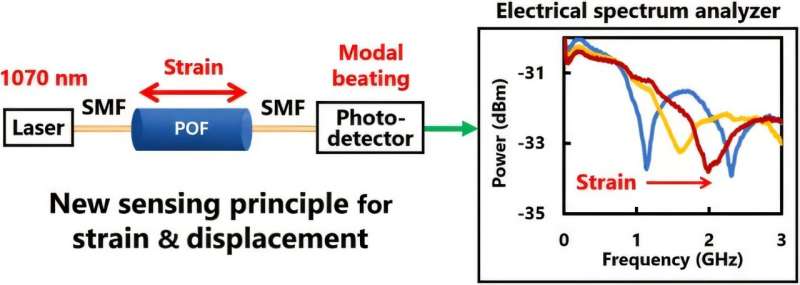
A new fibre-optic sensing technique is redefining how mechanical strain and displacement are measured by shifting signal interpretation from the optical to the electrical domain. Researchers at Yokohama National University have demonstrated a system in which interference patterns generated within an optical fibre are directly observed as variations in the electrical spectrum of a photodetected signal, thereby removing the need for conventional optical spectrum analysers.
At the core of the approach is a polymer optical fibre-based single-mode–multimode–single-mode (SMS) structure. As light travels through the fibre, it excites multiple propagation modes that interfere with each other. Instead of analysing these optical interference patterns using bulky optical instrumentation, the system converts them into electrical-frequency signatures that can be monitored more simply and efficiently.
The result is a measurable shift in electrical-domain interference dips when the fibre is subjected to strain or displacement. Experiments have shown that these changes are reversible and stable, allowing the sensor to reliably track mechanical deformation. Reported sensitivity reaches up to 3.7 MHz per micrometre of displacement, indicating strong potential for high-resolution sensing applications.
By eliminating the requirement for optical spectrum analysers, the technique significantly reduces system complexity, size, and cost. Traditional fibre-optic sensing systems often depend on expensive and delicate optical interrogation setups, limiting their deployment in compact or field-based applications. The new method instead shifts signal processing to the electrical domain, making integration with standard electronics more practical.
Researchers also highlight that the approach leverages multimodal propagation in polymer fibers to enhance signal richness, which improves the detectability of small mechanical changes. This makes it suitable for structural health monitoring, robotics, and precision industrial sensing, where real-time strain feedback is essential.
Beyond performance improvements, the architecture also opens pathways for scalable fibre sensing networks. Since electrical-domain readout is easier to multiplex and process, multiple sensing points could be integrated into distributed systems without proportional increases in optical hardware complexity.
While further optimisation is needed for temperature stability and long-term deployment, the development marks a step toward simpler, more accessible fibre-optic sensing platforms that more directly bridge photonics and electronics.

