

A quantum-dot-based photon emitter producing highly identical single photons at telecom wavelengths, offering stable, high-rate quantum light generation compatible with fibre-optic communication and scalable quantum networks.

A quantum-dot based photon emitter has been developed that produces nearly identical single photons at telecom wavelengths, marking a step forward for quantum communication systems that can integrate directly with existing fibre-optic infrastructure.
The device, developed by researchers at the University of Copenhagen’s Niels Bohr Institute, Ruhr University Bochum, the University of Basel, and Sparrow Quantum ApS, is built around semiconductor quantum dots embedded in a nanophotonic structure, engineered to emit single photons in the telecom O-band around 1,300 nm. This wavelength is critical because it aligns with minimal-loss transmission windows in standard optical fibres, making it highly relevant for long-distance quantum communication.
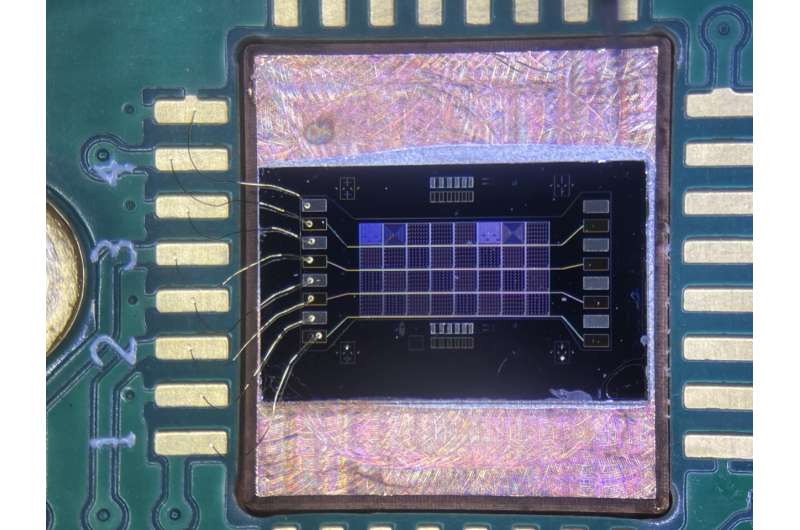
Unlike earlier quantum light sources that required filtering or wavelength conversion, the new system generates photons that are already compatible with telecom networks. The emitters are designed so that each excitation cycle releases one photon with tightly controlled quantum properties, ensuring consistency between successive emissions.
A key advance lies in the stability and coherence of the emitted photons. Researchers report that the system can produce tens of millions of photons per second while maintaining a very high degree of indistinguishability—meaning each photon behaves almost identically in its quantum state. This is essential for applications such as quantum key distribution, entanglement distribution, and future quantum internet architectures.
The emitter integrates quantum dots into a p-i-n diode and nanophotonic waveguide, allowing electrical control over charge noise that typically disrupts photon uniformity. This stabilisation ensures that environmental fluctuations do not significantly alter photon energy from one emission event to the next.
By embedding the dots into engineered photonic structures, the system also enhances emission efficiency and directs photons into usable optical modes. This improves brightness while preserving coherence, a long-standing challenge in solid-state quantum light sources.
The significance of the work lies in bridging two previously difficult requirements: high-quality single-photon emission and direct telecom compatibility. Earlier systems often excelled in one but not both, limiting scalability.
With this approach, researchers move closer to practical quantum networks where photonic chips, fibre infrastructure, and quantum emitters can operate within a unified telecom framework without additional conversion stages. While further scaling and integration remain challenges, the result strengthens the foundation for deployable quantum communication hardware built on semiconductor technologies.