


NASA’s new radiation-hardened processor delivers up to 500 times more computing performance than existing space-grade chips, enabling AI-driven spacecraft autonomy, faster navigation, and real-time onboard data processing.
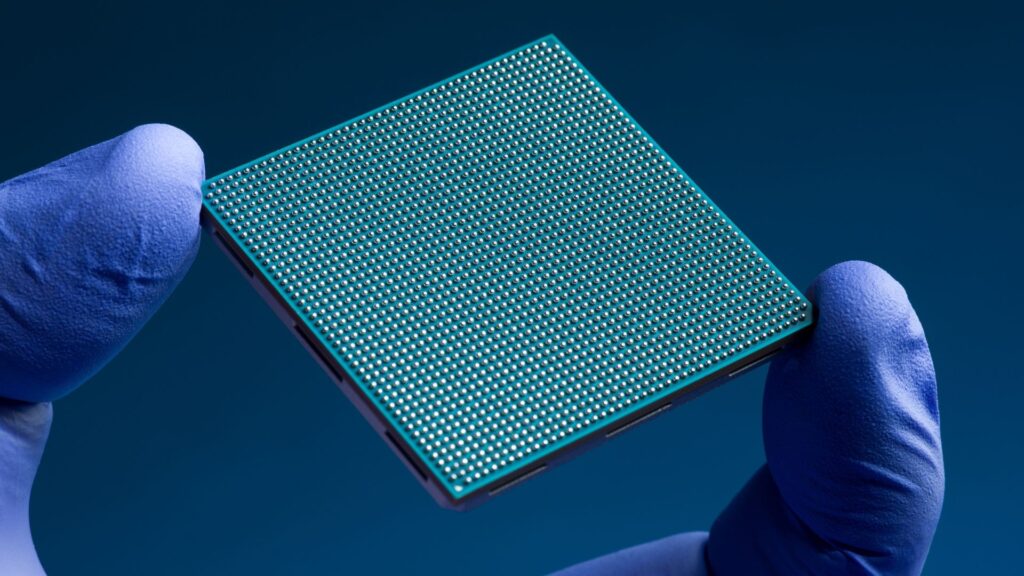
NASA has begun testing a next-generation radiation-hardened processor designed to dramatically increase onboard computing capability for future spacecraft missions. Developed under the High Performance Spaceflight Computing (HPSC) project in partnership with Microchip Technology, the new chip is expected to support autonomous navigation, real-time sensor analysis, and AI-powered decision-making in deep space.

According to NASA’s Jet Propulsion Laboratory (JPL), early testing shows the processor operating at nearly 500 times the performance of current radiation-hardened space processors. Existing spacecraft typically rely on decades-old chips because modern commercial processors cannot survive extreme radiation and temperature conditions encountered beyond Earth orbit.
The new system-on-chip integrates multiple processing functions into a compact architecture, including CPUs, networking, memory, high-speed interfaces, and computational accelerators. Built using a multicore 64-bit RISC-V architecture, the processor is designed for fault tolerance and continuous operation during long-duration missions to the Moon, Mars, and beyond.
NASA says the processor could reduce dependence on Earth-based computing by allowing spacecraft to process massive volumes of sensor data onboard. During simulations, the chip reportedly handled high-fidelity planetary landing scenarios that require rapid terrain analysis and hazard detection. Engineers also subjected the processor to radiation exposure, thermal cycling, shock testing, and electromagnetic interference assessments to validate reliability under deep-space conditions.
The processor is also expected to improve energy efficiency. Its scalable architecture allows unused subsystems to power down dynamically, extending mission life while reducing thermal load and power consumption. NASA believes the technology could eventually be deployed across orbiters, lunar habitats, planetary rovers, satellites, and crewed exploration systems.
Beyond space exploration, researchers see potential applications in terrestrial industries including aviation, autonomous systems, industrial automation, medical electronics, and AI edge computing.