





A compact motor-control reference platform enables efficient sensorless operation, fast startup, and scalable development of electronic oil pumps for automotive systems operating under extreme temperature and load conditions.
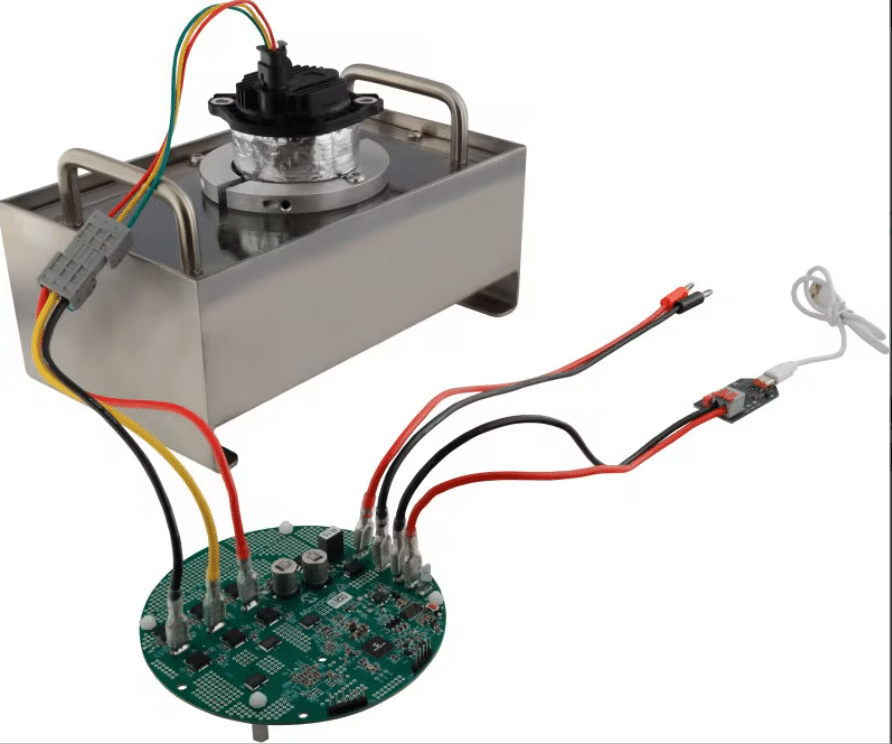
Modern internal combustion, hybrid, and electric vehicles increasingly rely on electrically driven oil pumps to maintain lubrication and thermal management under varying operating conditions. Unlike conventional mechanically driven pumps, electronic oil pumps (EOPs) must function efficiently across a wide speed range while responding rapidly to changing load demands. Microchip’s Automotive Oil Pump Reference Design provides design engineers with a compact, integrated platform for developing high-performance EOP systems, simplifying motor control implementation and reducing development complexity.
The reference design addresses one of the primary challenges of automotive oil-pump systems: maintaining reliable operation across extreme conditions. Automotive oil viscosity changes dramatically with temperature and may vary by as much as 2000 times between operating extremes. At temperatures below –30°C, viscosity increases significantly, creating high starting torque requirements and large mechanical loads on the motor. Despite these challenges, an EOP must start immediately and consistently whenever commanded. Additionally, transmission-related applications often require the pump to reach operational speed in approximately 100 ms to ensure rapid lubrication and fluid circulation.
At the heart of the design is a highly integrated System-in-Package (SiP) solution based on a 100 MHz dsPIC digital signal controller and integrated motor-control components. The architecture combines CAN communication functionality, MOSFET gate drivers, low-dropout regulation circuitry, and motor control capability into a single compact implementation. Such integration helps reduce board space, lower component count, and simplify PCB layout, which is especially beneficial for automotive designs constrained by space and thermal considerations.
The design uses sensorless Field-Oriented Control (FOC) technology to achieve high motor efficiency and quieter operation while eliminating the need for physical rotor-position sensors. Removing external sensors lowers system cost and improves reliability by reducing wiring and component complexity. The sensorless implementation also enables smoother startup characteristics and adaptive performance under changing load conditions. The system can operate across a broad speed range, from below 100 rpm to approximately 6500 rpm, while supporting peak power handling of up to 600 W in 12 V automotive environments.
It uses single-shunt current sensing, which reduces circuit complexity and BOM cost compared with multi-shunt approaches. The scalable software architecture allows code portability across the dsPIC33 family, enabling easier migration to different performance levels or application requirements. CAN connectivity further supports vehicle-network integration, diagnostics, and system-level communication. Beyond oil pumps, the reference platform can also be adapted for automotive water pumps, cooling systems, air-conditioning compressors, and fan-control applications, making it a flexible starting point for multiple motor-control designs.
For more information, click here.

