





Can a robot with a cryogenic spray stop wildfires before they spread? A robotic system is exploring a residue-free approach to tackling hotspots.
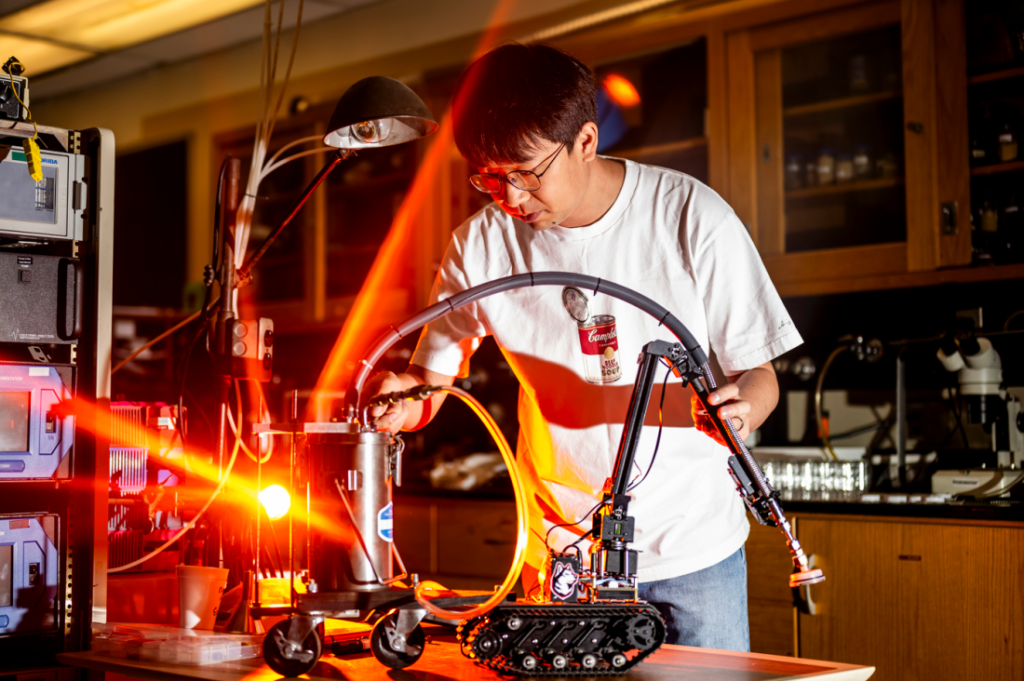
Researchers at Northeastern University have developed a prototype firefighting robot that uses liquid nitrogen to extinguish wildfires by rapidly cooling burning material and displacing oxygen. The system is designed to reach hazardous fire hotspots that may be difficult or unsafe for firefighters to access, offering an alternative approach to early wildfire suppression.
The concept emerged from laboratory experiments conducted by Yiannis Levendis, Professor of Mechanical and Industrial Engineering at Northeastern University, who observed that liquid nitrogen could rapidly extinguish flames by expanding into gas and reducing the oxygen available for combustion. Unlike conventional wildfire retardants, the cryogenic approach leaves no chemical residue, potentially reducing environmental impacts on soil and nearby water bodies.
To deliver the cryogenic agent, the research team built an all-terrain robotic platform equipped with caterpillar tracks and a spray system. Developed with the support of Northeastern students Hayden Hishmeh and Aobo Liu, the prototype is being evaluated on controlled fires using vegetation commonly found in wildfire-prone forests in the western United States. The robot is intended to suppress small fires before they develop into larger wildfires, and the concept could be adapted for either autonomous or remotely operated deployments.
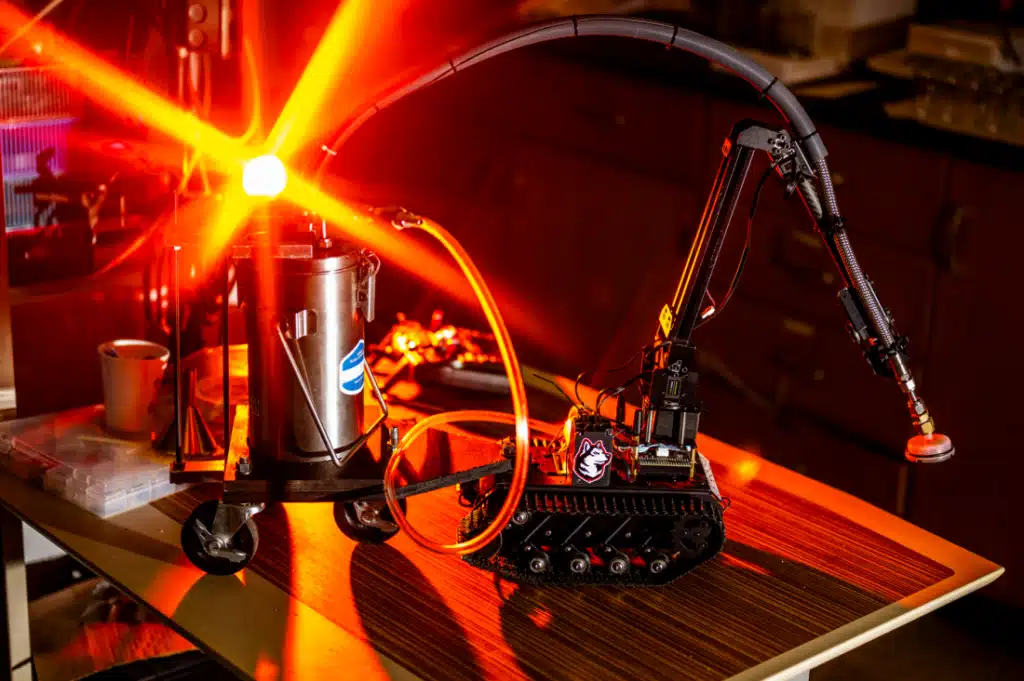
The project received funding from the Gordon and Betty Moore Foundation, enabling the team to develop the prototype and establish testing facilities. According to the researchers, the technology could also be scaled beyond robotic platforms, with potential integration into larger firefighting vehicles. The approach may complement existing wildfire response methods by targeting inaccessible locations while reducing risks to emergency personnel.
“Liquid nitrogen, when thrown on fire, quickly evaporates and expands into gas almost 1,000 percent. That suffocates the fire and creates a cooling effect on the fuel. I believe it can be converted to vehicles as large as firetrucks. We are fairly close,” says Yiannis Levendis, Professor of Mechanical and Industrial Engineering at Northeastern University.
