






A modular DC-DC reference design integrates power conversion and MCU-based control functions, helping engineers accelerate development, simplify testing, and reduce design complexity in automotive and industrial systems.
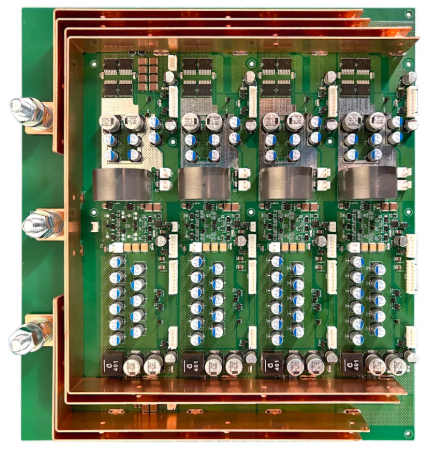
This design provides a ready development platform for building high-efficiency bidirectional DC-DC power systems for automotive and industrial applications. The RD210 platform from Toshiba is designed around a compact architecture that combines power conversion stages, input-output circuitry, and a dedicated MCU-based control board, enabling engineers to reduce design effort and accelerate prototyping and system evaluation. The reference design integrates both the power stage and control functions into a modular structure, allowing easier testing and optimisation during development.
The design consists of a main board that handles the DC-DC power conversion and associated interface circuits, while a separate control board positioned above it manages system control and operation. Such a split-board approach offers flexibility during development because engineers can independently evaluate control algorithms and power-stage performance without redesigning the complete hardware stack. This architecture can also simplify debugging and future scalability.
For design engineers working on next-generation power electronics, especially in automotive electrification, energy storage, and intelligent power systems, the design can serve as a practical development base rather than starting from a blank-sheet design. The reference design approach can significantly reduce circuit selection time and lower risks associated with power-stage optimization. Toshiba’s broader reference design ecosystem also provides supplementary resources such as schematics, PCB layout data, Gerber files, and software resources that can help shorten development cycles.
Another advantage of such a design methodology is the opportunity to study component interactions in real operating conditions. Power conversion systems increasingly demand high efficiency, thermal stability, and compact implementation. Instead of separately selecting MOSFETs, control devices, and isolation components, engineers can evaluate a pre-validated design and adapt it according to application-specific requirements. This can help reduce iterations during the early stages of hardware development.
The design is intended as a development reference and should undergo complete system-level validation before deployment in end products. Toshiba notes that engineers must evaluate performance, reliability, safety standards, and operating conditions according to their target applications before integrating the design into commercial systems.
For engineers developing power electronics systems, the RD210 platform provides a useful starting point for faster development, reduced engineering effort, and more efficient design exploration in complex DC-DC conversion applications. For more information, click here.
