

Imagine cooking with a stove that uses nothing more than water and electricity to generate fuel on demand. With no need for cylinders or pipelines, it challenges conventional ideas about how energy reaches the kitchen. This is not ‘burning water’ but a fundamentally different approach to fuel generation. Could it eventually rival LPG and induction cooking in India?
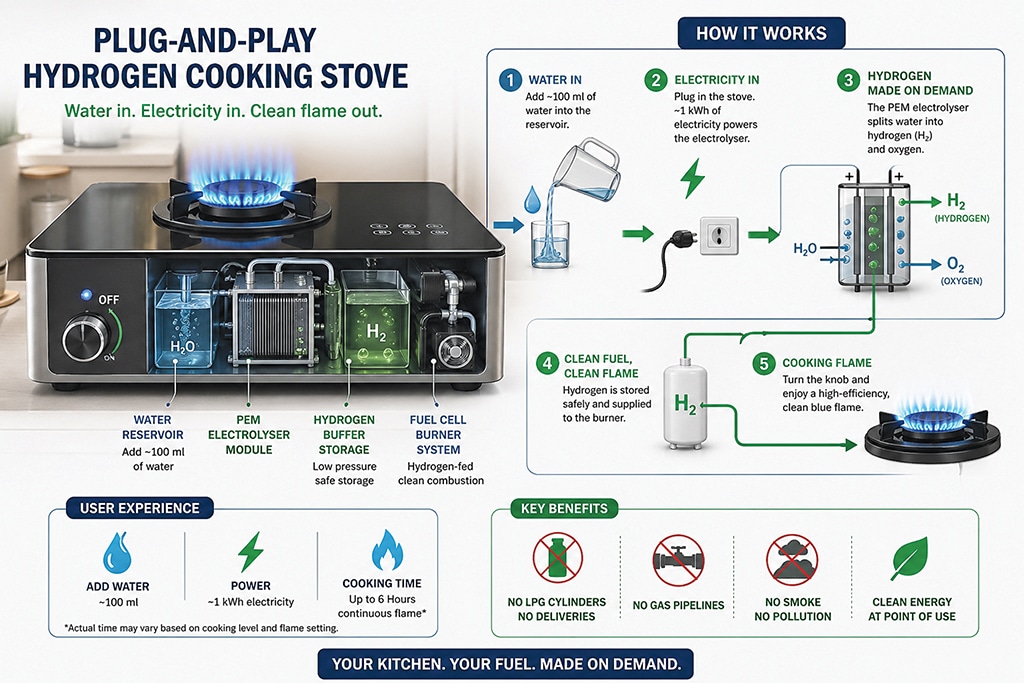
According to the International Energy Agency, almost 2.3 billion people continue to rely on environmentally damaging fuels. As countries move towards sustainable energy sources, there is growing interest in hydrogen as an energy carrier. Hydrogen cookers are now emerging whose primary function is to produce hydrogen fuel from water and electricity, eliminating the need for LPG cylinders or hydrogen pipelines.
In collaboration with India’s oil and natural gas industry, Greenvize, a cleantech startup, has developed a portable hydrogen stove for domestic and commercial applications. At the heart of the device is a proton exchange membrane (PEM) electrolyser integrated into a stove-like appliance.
Water is not the fuel source; it is the feedstock used to produce hydrogen. Electricity is used to split water molecules and generate hydrogen, which is then combusted. This process introduces energy losses that make the overall system less efficient than LPG and induction cooking. However, a major advantage is that hydrogen is produced continuously on demand, eliminating the need for fuel replenishment, storage tanks, and distribution infrastructure. The device requires only 100 millilitres of water and approximately 1kWh electricity to operate.
From water to flame: The science at the core
The operating principle of a hydrogen stove is straightforward. It relies on electrolysis, in which electricity splits water into hydrogen and oxygen. This reaction occurs in a PEM electrolyser, where hydrogen is generated at the cathode and oxygen is released at the anode.
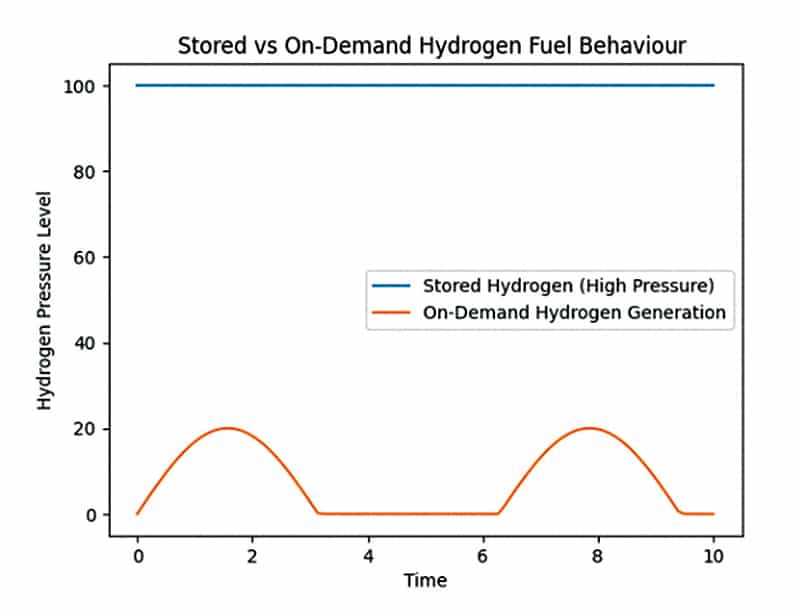
Unlike older systems that depended on high-pressure hydrogen storage, these stoves generate hydrogen only when required. As a result, dedicated fuel storage and transportation systems may no longer be necessary.
The PEM electrolysers used in small-scale systems typically operate at 1.8V to 2.2V and current densities of 1A/cm² to 2A/cm². These parameters influence hydrogen production rates, temperature management, and system longevity. Water quality, temperature regulation, and electrode degradation are also critical factors in these small-scale systems.
Electricity, rather than water, is the true source of energy. Electrolysis typically operates at 65-75% efficiency, while additional losses occur during hydrogen combustion, making overall efficiency broadly comparable to LPG but lower than that of induction cookers.
During combustion, hydrogen is converted primarily into water vapour, producing very little direct air pollution. At first glance, this makes it appear to be an exceptionally clean fuel. However, the key consideration is the source of the electricity used to generate the hydrogen.
Safety presents another significant challenge. Hydrogen ignites easily, and its flame is nearly invisible to the naked eye. In practical situations, this can make leaks or fires difficult to detect quickly. This characteristic can significantly increase operational risk in real-world applications.
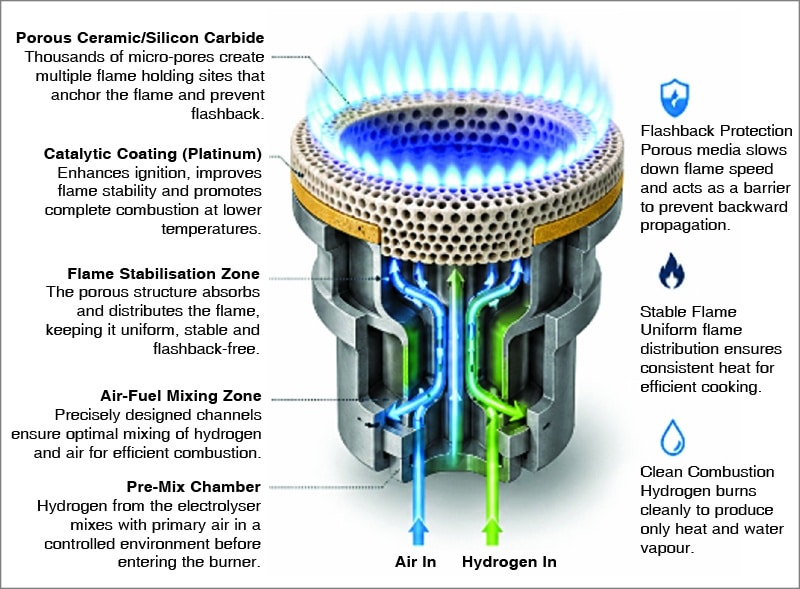
To address these challenges, modern hydrogen cooking systems are carefully engineered. They typically incorporate durable, heat-resistant burner materials such as ceramics and silicon carbide (SiC) to enhance operational safety. In addition, catalysts such as platinum are used to improve reaction efficiency and provide better process control.
This raises an important question: Is hydrogen truly a clean fuel, or is it only as clean as the energy used to produce it?
Inside the appliance: A micro energy system