


New ultra-wideband technology combines secure ranging, sensing and positioning to simplify connected device design while reducing power consumption across automotive and industrial applications.
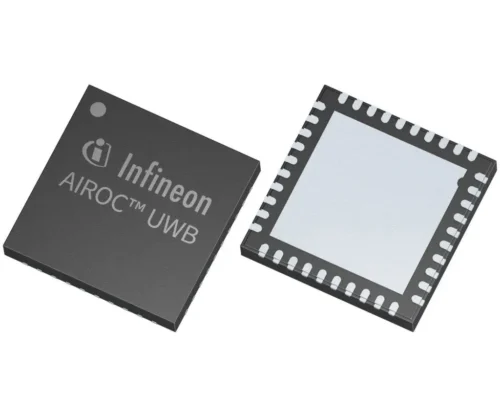
Infineon Technologies has begun sampling its first-generation AIROC™ UWB TSL100 family, introducing a scalable ultra-wideband (UWB) platform designed for secure ranging, positioning and sensing applications. The new product family features a low-power architecture, enhanced security and compliance with emerging IEEE 802.15.4ab, CCC, Aliro and FiRa standards, providing developers with a future-ready solution for connected devices.
The AIROC UWB TSL100 integrates precise ranging and sensing capabilities into a single chip, reducing system complexity by eliminating the need for separate sensing subsystems. The devices support a wide range of applications, including secure vehicle and building access, digital keys, in-cabin presence detection, asset tracking, indoor navigation, contactless payments and industrial collision avoidance.
The family is available in two variants. The TSL111A targets automotive OEMs and Tier-1 suppliers, supporting digital key, kick sensing, intrusion detection and NCAP-compliant presence detection. The TSL111C is designed for consumer and industrial applications, enabling smart access, indoor positioning, asset tracking and tap-free payment systems.
Key features include exceptionally low power consumption, allowing coin-cell-powered key fobs to operate for more than two years, while a dedicated low-power mode reduces current consumption by over 50%. The platform also delivers high FiRa/CCC security with robust performance in challenging non-line-of-sight environments, alongside cost-optimised sensing functions and configurable zoning technology for reliable access control.
To accelerate development, Infineon is also providing an engineering sample kit that enables system-level evaluation of ranging accuracy, sensing coverage and power consumption. The platform is intended to shorten development cycles and speed the deployment of next-generation UWB-enabled products across automotive, consumer and industrial markets.
Click here for the original announcement.