

The Program-as-Weights approach could automate programming tasks while reducing dependence on cloud-based AI models.
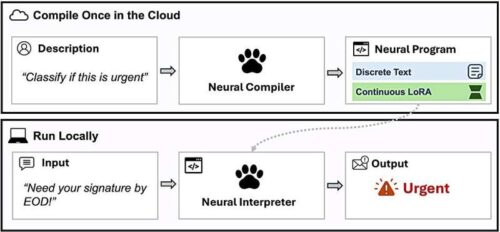
Researchers at the University of Waterloo, Cornell University, and Harvard University have created a new AI programming paradigm known as Program-as-Weights (PAW) that could help automate software programming tasks while reducing dependence on cloud-based large language models (LLMs). The new concept has been explained in an article available on the arXiv preprint server. According to the paper, PAW relies on the “compile once, run locally” principle where developers write plain English instructions, which are converted into a small AI add-in that can be reused repeatedly. The researchers say the method could help cut cloud computing expenses, reduce the risk of personal information leaks, provide offline functionality and avoid disruption of software because of updates to cloud-based AI models.
Unlike approaches that send every user instruction to a large AI model, PAW compiles a small AI tool that can run on a laptop or phone using a lightweight AI model. “PAW reimagines the foundation model as a tool-builder instead of a per-input problem solver,” stated in the paper.
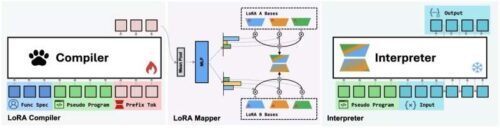
PAW was tested on the FuzzyBench benchmark which consists of 10 million examples of fuzzy programming tasks that include tasks like log filtering and fixing broken JSON files. A tiny AI model with PAW was compared to Qwen3-32B which has more than 50 times as many parameters. Qwen3-32B scored 68.7 per cent on the researchers’ benchmark, while PAW scored 73.78 per cent. PAW can process around 30 tokens per second with a 430-megabyte quantised interpreter on a MacBook M3.
The researchers have released the PAW source code alongside the paper. Discussing the long-term vision, they stated, “We hope Program-as-Weights contributes to a future in which small LMs serve as the runtime, where large models compile and small models execute.”