




A spray-based immersion cooling technology significantly improves lithium-ion battery thermal management, cutting dielectric liquid use while enhancing fast-charging safety, reducing system weight, and enabling safer EV and energy storage applications.
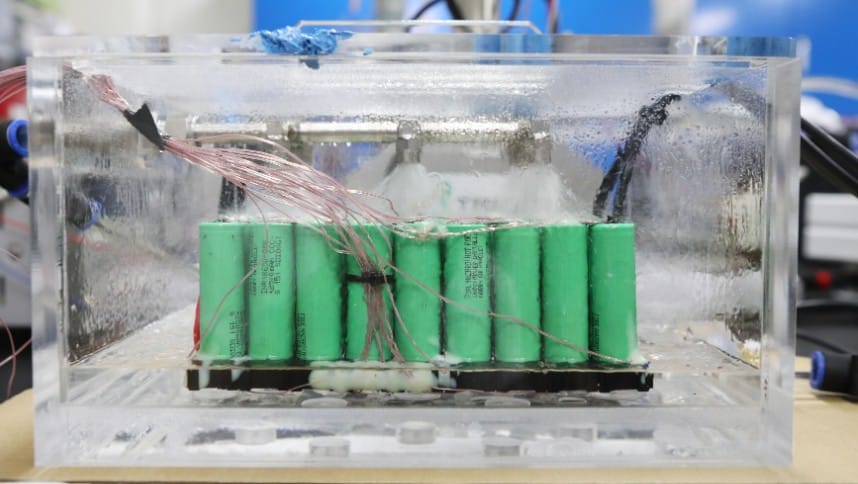
Researchers at the Korea Institute of Machinery and Materials (KIMM) have developed a spray-based immersion cooling technology that improves thermal management for lithium-ion battery packs while drastically reducing the amount of dielectric liquid required. Designed to address overheating and thermal runaway during high-power operation, the technology combines targeted spray cooling with partial immersion to deliver efficient heat removal using only a fraction of the coolant required by conventional immersion systems.
As electric vehicles and large-scale energy storage systems increasingly demand faster charging and higher power densities, conventional air- and liquid-cooling methods are approaching their thermal limits. Traditional immersion cooling offers better heat transfer but requires battery packs to be completely submerged, increasing system weight, coolant volume and overall cost. KIMM’s approach overcomes these limitations by spraying dielectric liquid directly onto the upper surface of battery cells while keeping the lower section partially immersed, enabling effective cooling through both direct heat transfer and forced convection.
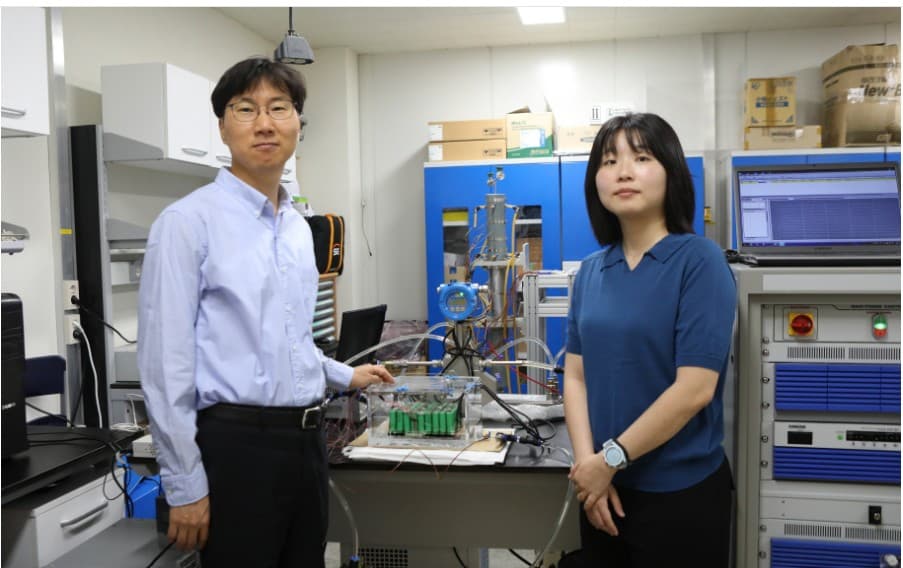
The hybrid cooling mechanism demonstrated stable thermal performance during rapid charging and discharging, maintaining battery pack temperatures below 35°C. Compared with conventional immersion cooling, the new design reduces dielectric liquid consumption by approximately 85%, resulting in lighter cooling systems and lower operating costs without compromising thermal stability.
Beyond improving thermal efficiency, the dielectric liquid used in the system is non-flammable, providing an additional layer of protection against battery fires and helping mitigate thermal runaway. This combination of cooling performance and inherent fire-suppression capability makes the technology suitable for battery packs used in electric vehicles, stationary energy storage systems, and data centre backup power installations, where battery safety is critical.
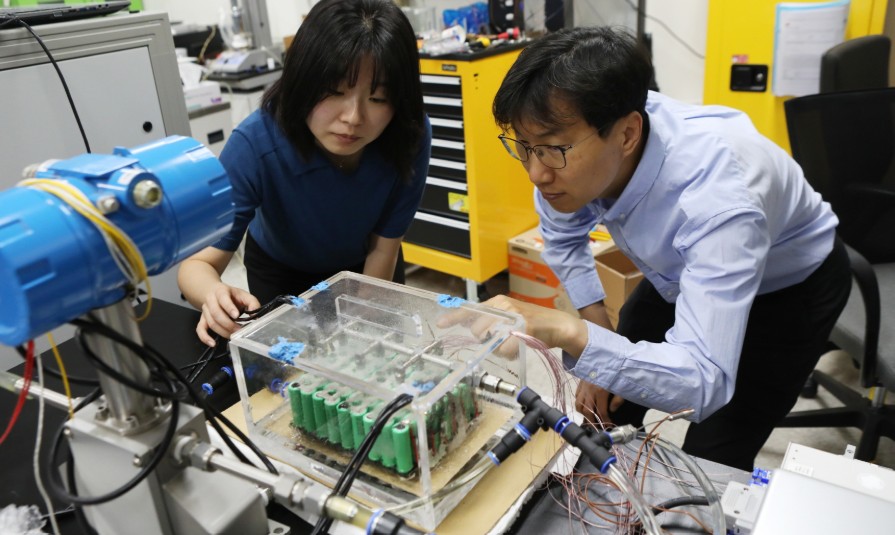
The researchers also identified key thermophysical properties of dielectric liquids that maximise cooling efficiency and plan to extend the work using AI-based optimisation techniques to discover next-generation cooling fluids. The research forms part of a broader programme focused on advanced thermal management technologies for energy-efficient infrastructure and has been published in Applied Thermal Engineering, highlighting its potential to influence future battery cooling architectures for high-performance energy systems.


