




A battery-powered Arc Reactor replica uses an ESP32-C3 to control 24 addressable LEDs without a separate level shifter.
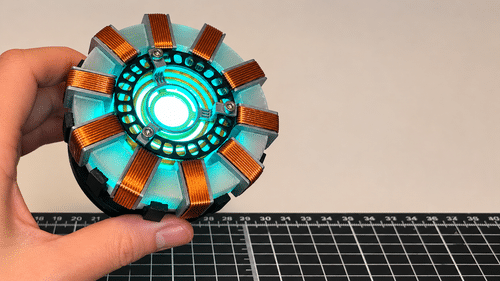
A developer named Yiğit has made a self-contained, battery-powered replica of the Mark I Arc Reactor using a Seeed Studio XIAO ESP32-C3 microcontroller and a 24-LED WS2812B NeoPixel ring. The design drives the LEDs using low-voltage power supply, which enables direct control of the LEDs by the ESP32-C3 without any additional components such as a logic level shifter.

The control of the LED ring is done via GPIO pin 3. In this project, the feature of the WS2812B regarding its supply-dependent input high threshold value is used to achieve the ability to communicate directly with the ESP32-C3 microcontroller using its 3.3V GPIO pin. This input threshold value is set to be 0.7 times the value of the supply voltage for the WS2812B.
One 3.7V lithium polymer battery is used to power the device. The circuit consists of a TP4056 charger circuit as well as a slide switch. This project originally faced reset issues caused by brownouts. In order to solve the issue, the program code disables Wi-Fi and Bluetooth initialisations and lowers the clock speed of the RISC-V processor on the ESP32-C3 chip to 80MHz.
The firmware will create a cyan lighting effect through a combination of RGB values of 15, 200 and 255. The brightness is in the range of 20 to 150, while the changes happen at every 25 milliseconds. The electronic components will be contained in a 3D-printed case, which is manufactured from PETG and PLA plastics.

The circuit demonstrates that the choice of supply voltage and power management by firmware can be beneficial in a simple LED circuit powered by a battery. Choosing low supply voltage to drive the WS2812B ring eliminates the need for a level shifter. In addition, deactivating the wireless capability of the device and slowing down the processor solve the problem of brownout resets.
For more information, click here.
