




The University of Tokyo and Max Planck Institute for Informatics developed a facial movement analysis method that detects deepfakes with over 95% accuracy consistently.
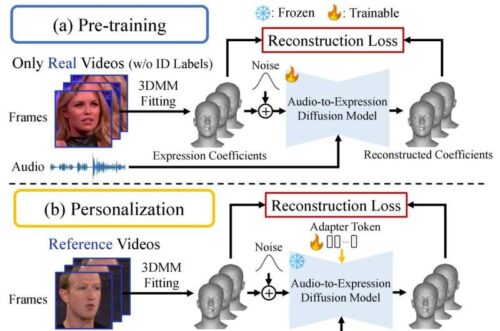
The University of Tokyo and the Max Planck Institute for Informatics have developed a new deepfake detection approach that analyses facial movements instead of searching for visual artefacts, achieving an average detection accuracy of more than 95% across established benchmark datasets. The technique, called ExposeAnyone, also maintained high performance when tested against videos generated using OpenAI’s Sora 2.
Rather than examining suspicious pixels or image inconsistencies, the method predicts how a person’s facial expressions should naturally correspond to the accompanying speech. Researchers compare these predicted expressions with those visible in a video. Significant differences between the two indicate that the footage may have been manipulated.
The system is based on a self-supervised learning approach, enabling it to train exclusively on authentic videos instead of relying on extensive collections of labelled fake content. Researchers pre-trained the model using more than 450 hours of publicly available video footage, allowing it to learn natural relationships between speech and facial expressions represented by the widely used FLAME facial model.
To personalise detection, the system can be fine-tuned using approximately 60 seconds of video from a specific individual. This effectively creates a tailored detector capable of identifying inconsistencies in that person’s facial movements, making it more resilient against previously unseen manipulation techniques and image distortions such as compression or noise.
The researchers said the method outperformed previous detection systems, particularly on a challenging benchmark featuring videos generated by advanced generative AI models. While earlier detectors achieved results only slightly better than random guessing on this dataset, the new approach correctly identified almost 95% of manipulated videos.
Despite its promising performance, the team acknowledged that the system currently requires extensive pre-training on powerful computing hardware and is not yet suitable for real-time deployment. Nevertheless, the researchers believe the approach represents an important step towards more robust and adaptable deepfake detection systems capable of keeping pace with rapidly evolving AI-generated content.

