

A prototype smart garment integrates embedded electronics, environmental sensors and airbag protection to improve navigation, fall detection and emergency response for blind and visually impaired users during everyday travel.
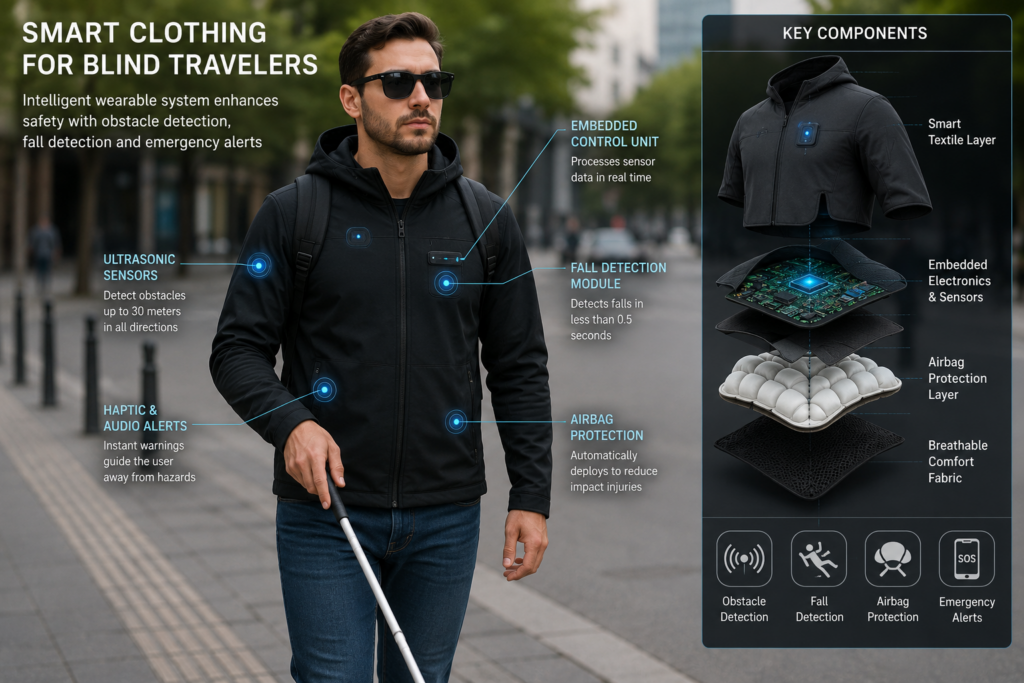
Researchers have developed a smart wearable system that combines embedded electronics, environmental sensing and automated safety features to enhance mobility and protection for blind and visually impaired individuals. The intelligent garment integrates multiple electronic modules into everyday clothing, enabling obstacle awareness, rapid fall detection and emergency response without relying on handheld assistive devices.
Unlike conventional mobility aids such as white canes, the prototype extends assistance beyond navigation by incorporating real-time hazard monitoring and impact protection. Embedded sensors continuously analyse the wearer’s surroundings and trigger warning alerts when potential obstacles or dangerous situations are detected. During testing, the warning system maintained reliable performance at distances of up to 30 meters, even in complete darkness, demonstrating its potential to improve situational awareness in low-visibility environments.
A key technological feature is its integrated fall-detection module, which identifies falls in less than half a second. The rapid response allows an onboard airbag protection system to deploy before impact, helping reduce the risk of serious injuries. This combination of embedded sensing, fast data processing and automated mechanical protection represents a significant advancement in wearable safety electronics for assistive applications.
The smart clothing incorporates an embedded computing platform directly into the fabric, allowing multiple electronic components and sensors to operate seamlessly without requiring external devices. The system continuously monitors environmental conditions and user movement while providing real-time feedback, creating a wearable platform capable of supporting both daily mobility and emergencies.
Researchers believe the technology addresses an important gap in assistive electronics. While existing solutions primarily focus on obstacle detection and route guidance, fewer systems integrate accident detection, emergency alerts and physical impact protection into a single wearable device. The multifunctional design demonstrates how intelligent textiles can evolve into comprehensive personal safety systems.
Despite the promising results, several engineering challenges remain before commercial deployment. Integrating electronic hardware into clothing can reduce wearer comfort, while the long-term durability of embedded components under repeated use and washing still requires validation. Manufacturing consistency, cybersecurity, user data privacy and regulatory compliance must also be addressed to ensure reliable large-scale production. Continued advances in flexible electronics and smart textile engineering could help transform such wearable systems into practical assistive technologies for everyday use.