





Sandia National Laboratories developed a laser-based crystal sensor that accurately measures intense magnetic fields in radiation-heavy fusion environments, improving diagnostics and reactor reliability.
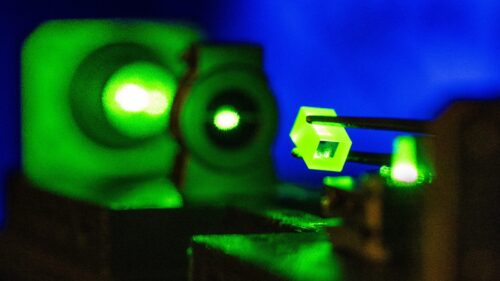
Researchers at Sandia National Laboratories have developed a compact laser-based crystal sensor capable of accurately measuring extremely intense magnetic fields in harsh environments, offering a promising new diagnostic tool for future fusion power plants. About the size of a pencil eraser, the device is designed to withstand radiation, electromagnetic interference and fusion plasma conditions that often overwhelm conventional magnetic field sensors.
The sensor uses a rare-earth garnet crystal together with a small laser, optical filters and a light detector. As laser light passes through the crystal, its polarization changes in response to the surrounding magnetic field. By measuring these optical changes, the system can determine magnetic field strength with high precision. Researchers used crystals made from terbium scandium aluminum garnet (TSAG) and terbium gallium garnet (TGG), whose optical properties respond strongly to electromagnetic forces.
Development began in 2021 to improve magnetic field measurements inside Sandia’s Z Machine, the world’s most powerful laboratory radiation source. The technology was subsequently tested at Sandia’s High-Energy Radiation Megavolt Electron Source III (HERMES III) and the Short Pulse High Intensity Nanosecond X-Radiator (SPHINX), where it matched the performance of conventional sensors while delivering more consistent measurements under extreme conditions.
Unlike conventional metallic probes, the crystal-based sensor requires less frequent calibration and maintenance and is electrically insulating, preventing failures caused by radiation-induced electrical interference. Researchers believe these advantages could reduce operating costs while improving the reliability of fusion diagnostics.
The team is now evaluating the sensor in low-density plasma after successful testing in air and vacuum, with plans to validate it in the high-density plasma conditions required for commercial fusion reactors. Sandia has secured a patent for the technology, and one company has already licensed it. Researchers believe the innovation could become a key diagnostic tool for monitoring magnetic fields that confine superheated plasma, helping improve reactor stability and advancing the commercialization of fusion energy.
