

Northwestern University researchers developed the Phantom Twist drone, using motion blur and AI-driven optimisation to reduce visibility while maintaining stable flight performance significantly.
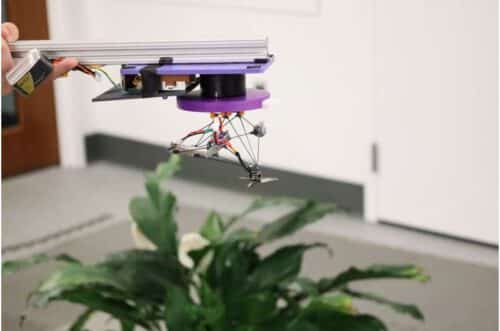
Northwestern University has developed Phantom Twist, a drone designed to become far less noticeable during flight by exploiting human visual perception instead of traditional camouflage. The prototype uses motion blur created by rapid rotation, combined with artificial intelligence and optimisation algorithms, to reduce how easily it can be seen while remaining stable in the air.

Unlike conventional quadcopters that have four stationary arms with spinning propellers, the new design features a single propeller while the rest of the drone rotates in the opposite direction. Spinning at up to 25 revolutions per second, the aircraft appears as a faint, semi-transparent blur rather than a clearly defined object, allowing it to blend more naturally into its surroundings.
To develop the drone, researchers first generated around 20,000 possible configurations capable of stable flight. Artificial intelligence and optimisation software then repeatedly adjusted the positions of the motor, propeller, batteries, circuit board and counterweight to identify designs with the lowest visual detectability. The most promising candidates were tested against realistic backgrounds using a perception model that approximates human vision.
According to the research team, the final design is around ten times less visually perceptible than a conventional quadcopter. By spacing components at different heights and angles, the rotating parts merge visually during flight, producing a hazy appearance instead of a recognisable shape.

The researchers believe the technology could benefit wildlife monitoring, environmental surveys and infrastructure inspections, where highly visible drones may disturb animals or alter human behaviour. A less conspicuous aircraft could perform the same tasks with reduced visual disruption.
The prototype still has limitations. Its propeller produces audible noise, while wires and supporting rods remain visible. The team plans to investigate quieter propulsion systems and more transparent materials to further reduce the drone’s detectability in future versions.