


A common plastic additive can simultaneously improve the brightness and stretchability of OLED materials, offering a simple route to durable wearable displays and soft electronics.

A team at the University of Chicago Pritzker School of Molecular Engineering (UChicago PME) has demonstrated a simple materials engineering approach that significantly improves both the optical performance and mechanical flexibility of stretchable organic light-emitting diode (OLED) materials. By incorporating a commercially available plasticiser into light-emitting polymer films, the researchers achieved brighter emission while increasing the material’s ability to stretch—addressing a major trade-off in wearable display technology.

Stretchable OLEDs are considered a key building block for next-generation wearable electronics, electronic skin, soft robotics and three-dimensional displays. However, making OLED materials elastic has traditionally reduced their light-emission efficiency because stretching disrupts the arrangement of polymer chains responsible for generating light. This compromise has limited the practical deployment of highly deformable OLED displays.
Instead of designing entirely new emissive polymers, the UChicago team adopted a simpler strategy by blending conventional light-emitting polymers with a widely used plastic softener commonly found in flexible consumer plastics. The plasticiser inserts itself between polymer chains, increasing molecular mobility and allowing the film to deform more easily under strain. At the same time, the modified structure reduces energy losses that typically occur during light emission, resulting in higher brightness without sacrificing flexibility.
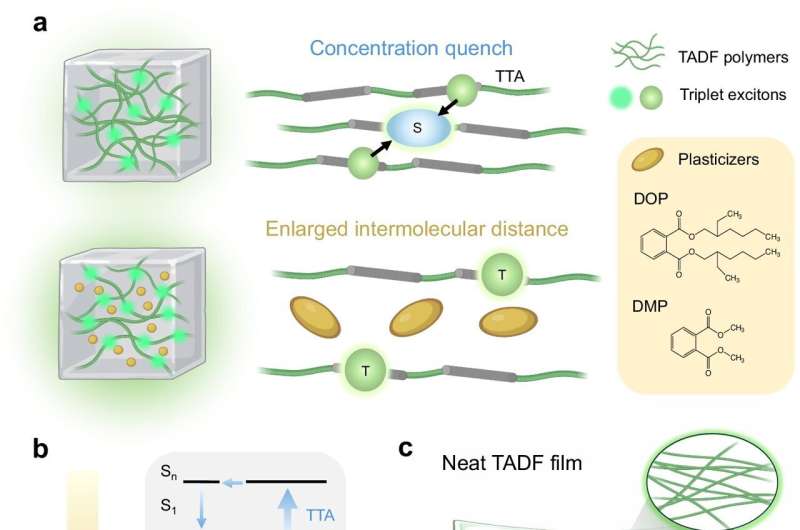
The approach was validated across multiple thermally activated delayed fluorescence (TADF) polymer emitters producing different colours, demonstrating that the technique is not limited to a single OLED material. Because the additive is already commercially available and compatible with existing polymer-processing methods, the technology could be integrated into current OLED manufacturing workflows without requiring complex chemical synthesis or new fabrication equipment.

The researchers believe the discovery could accelerate the development of conformable electronic systems that integrate sensing, computing, communication and visual feedback directly on flexible or wearable platforms. Applications include smart health patches, electronic textiles, foldable consumer electronics, humanoid robots and lightweight display systems where both mechanical durability and high optical efficiency are essential.
By replacing complex molecular redesign with a straightforward material formulation, the work provides a scalable route for manufacturing brighter, more resilient stretchable OLEDs, potentially reducing development costs while expanding the capabilities of future flexible electronic devices.