KAIST researchers develop a terahertz inspection technique that detects nanometre-scale electrode thickness variations in lithium-ion batteries, enabling rapid, non-destructive quality control for EV battery manufacturing.
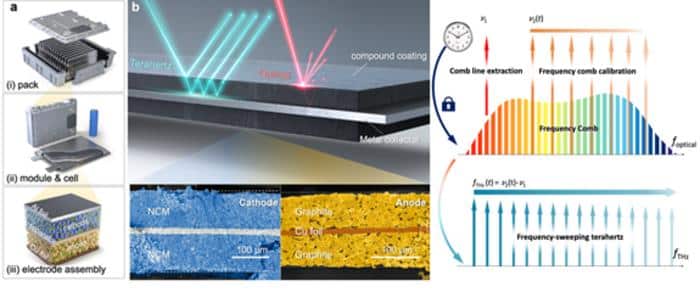
Researchers at the Korea Advanced Institute of Science and Technology (KAIST) have developed a high-precision terahertz inspection technology capable of detecting nanometre-scale thickness variations in lithium-ion battery electrodes without disassembling or damaging the cell. The technique could help manufacturers identify defects that contribute to thermal runaway, improving the safety and reliability of electric vehicle (EV) batteries.

Uniform electrode thickness is critical in lithium-ion batteries because even slight variations can concentrate current during charging and discharging, generating localised heat. Persistent hotspots can trigger thermal runaway, one of the leading causes of battery fires. Existing inspection methods, including X-ray computed tomography (CT), ultrasonic acoustic microscopy and laser displacement sensors, either require long inspection times, contact with liquids or lack sufficient internal measurement precision for high-speed production lines.
The KAIST team addressed these limitations by combining terahertz-wave imaging with an optical frequency comb. Terahertz waves are directed through the battery electrode, where multiple internal reflections create Fabry-Pérot interference patterns. Using the optical frequency comb as a precise reference, the system analyses these interference fringes to calculate electrode thickness and determine the material’s complex refractive index simultaneously, eliminating the need for separate calibration.
The prototype was evaluated on battery electrodes measuring 50–150 µm thick, comparable to the diameter of a human hair. In just 0.2 seconds, the system detected thickness differences as small as 70.1 nm in anodes and 465.5 nm in cathodes, making it suitable for inline inspection on fast-moving production lines. Extending the measurement time to 25.6 seconds further improved precision to 7.8 nm for anodes and 25.2 nm for cathodes—approximately one ten-thousandth the thickness of a human hair and up to 100 times more precise than conventional techniques.

Beyond measuring thickness, the integrated metrology platform simultaneously characterises material properties, offering a comprehensive quality assessment tool for battery manufacturers. The researchers believe the technology can support real-time process monitoring for both current lithium-ion batteries and emerging solid-state battery technologies, enabling earlier defect detection and reducing manufacturing variability.