Thinking about a new TV? Before paying extra for HDMI 2.2, here is what matters, what does not, and how to buy wisely.
The trajectory of display technology has moved at a relentless pace, evolving from the legacy of standard definition to the ubiquity of Full HD, and eventually the mainstream adoption of 4K. Today, the horizon is set on 8K and even 16K resolutions, pushing the limits of silicon and signal transmission. At the heart of this transformation is the High-Definition Multimedia Interface (HDMI).
The emergence of HDMI 2.2 represents more than a minor iteration; it signals a new phase of uncompressed throughput and immersive media. As home entertainment ecosystems become increasingly sophisticated, this standard serves as the fundamental physical layer for the next generation of visual fidelity. For the modern consumer, the arrival of this standard necessitates a strategic evaluation: how should HDMI 2.2 influence current TV buying decisions?
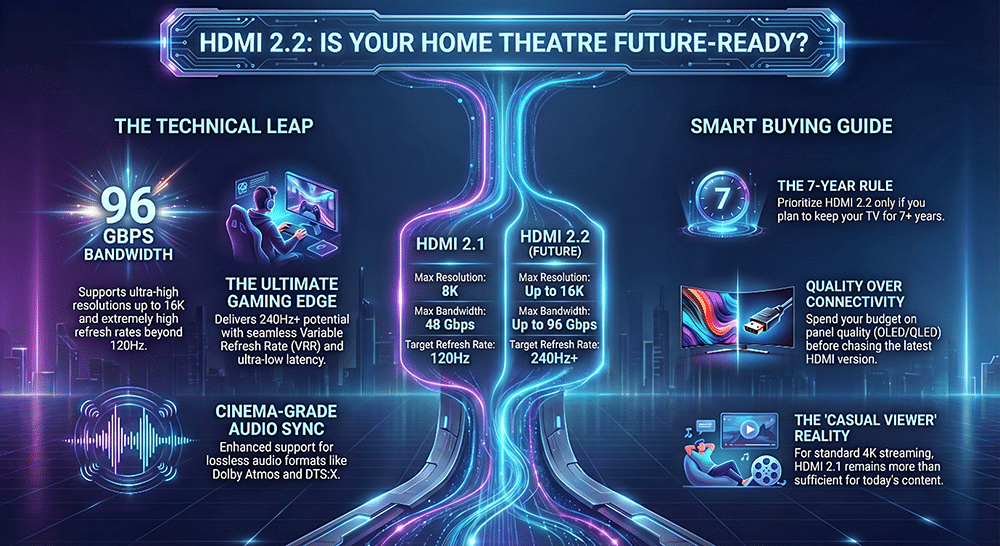
Deconstructing HDMI 2.2: Technical specifications and bandwidth
Industry projections indicate significant technical advancements to accommodate the data-heavy requirements of future 16K panels and high-frequency refresh cycles. The core specifications that define the standard’s engineering limits are given in the table on next page.
The leap to ~96Gbps is a critical engineering milestone. Previous standards often required heavy chroma subsampling (reducing colour data) or restricted bit depth to fit within a smaller ‘data pipe.’ This substantial bandwidth expansion helps maintain signal integrity for uncompressed 8K at 120Hz, providing the overhead necessary for 10-bit and 12-bit HDR (high dynamic range) without losing fine detail to compression artefacts.
Inherited and enhanced features: The technical core
HDMI 2.2 optimises the high-performance features introduced in version 2.1, refining them for ultra-high-bandwidth environments where signal timing is paramount:
Variable refresh rate (VRR)
Refined for seamless performance, allowing the display to match the source’s frame rate dynamically, effectively eliminating screen tearing and stutter.
Auto low latency mode (ALLM)
Ensures the display automatically switches to its lowest-latency processing path when a gaming signal is detected, minimising the lag between input and on-screen action.
Enhanced audio return channel (eARC)
Optimised to handle uncompressed, high-bitrate audio formats, eARC is essential for transmitting lossless object-based audio to external processors.
The gaming paradigm: Performance and competitive edge