





Can laser light direct electrons without electricity? Researchers have demonstrated a new semiconductor effect that could reshape future optoelectronic devices.
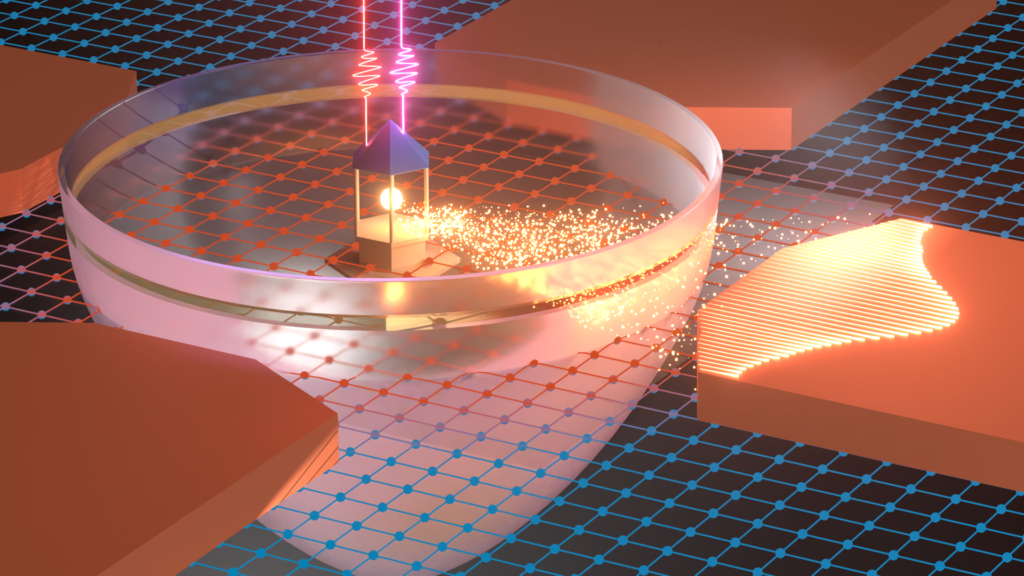
Researchers at the University of Michigan have developed a semiconductor device that controls the direction of electron flow using laser light alone, eliminating the need for an applied electric field. The work demonstrates a previously unobserved quantum phenomenon and could support future advances in sensing, telecommunications, imaging and other optoelectronic technologies.
The device was created to investigate fundamental quantum physics, but the underlying mechanism could also improve how electronic and optical systems exchange and process information. By precisely directing electron movement with light, the approach may enable more efficient signal transmission and create new ways to encode and store information within optical communication systems.
The researchers generated an electronic current by illuminating the semiconductor with two laser pulses of different colours. Instead of relying on an external voltage, the interaction between the two laser beams drives electrons through the material. By rotating the polarisation of the laser beams, the team was also able to steer the direction of the electron beam, allowing it to sweep across the device in a manner similar to a lighthouse beam.
The effect is based on quantum interference, where two optical absorption pathways created by different light frequencies converge on the same electronic state. Constructive interference enhances electron motion in one direction, while destructive interference suppresses movement in others, producing a narrow and controllable electron beam. The device was fabricated at the University’s Lurie Nanofabrication Facility, where researchers developed a specialised manufacturing process to minimise unwanted electric fields that could interfere with the experiment.
“This isn’t the way things normally work. When you think about electrons moving through a material, they’re moving because you’ve applied an electrical field,” says Steven Cundiff, Senior Author of the study and Professor of Physics at the University of Michigan. “Here, using light, you can actually sort of squirt the electrons in a specific direction without applying an electric field.”

