


A new development platform combines high-performance AI processing, large memory capacity, and industrial connectivity, enabling developers to accelerate edge AI, robotics, machine vision, and smart automation applications.
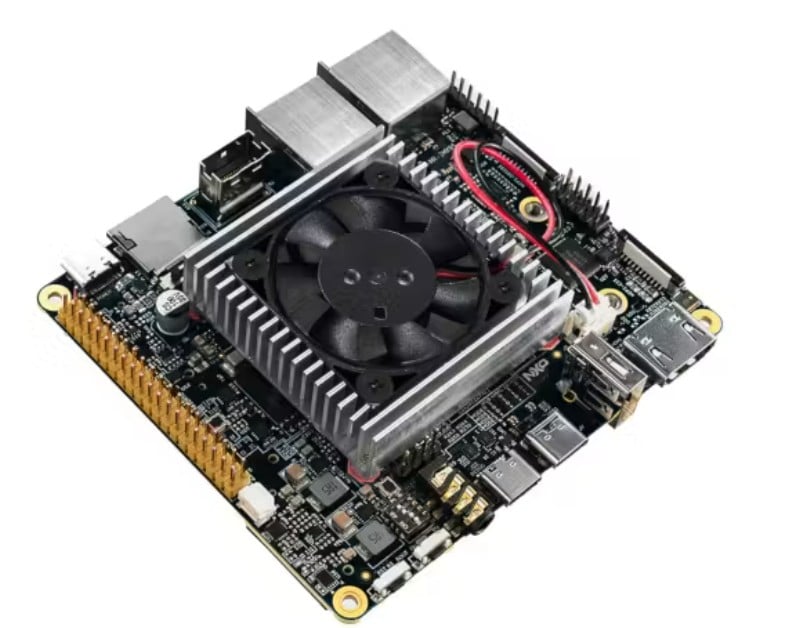
The NXP FRDM i.MX 95 Pro development board by NXP Semiconductors, powered by the i.MX 95 application processor is designed to speed up the development of compute-intensive edge artificial intelligence (AI) systems. The platform integrates high-capacity memory, dedicated neural processing hardware, and extensive connectivity, allowing engineers to prototype demanding machine learning and vision applications without requiring a custom hardware design.

Built around the i.MX 95 processor features six Arm Cortex-A55 cores alongside Cortex-M33 and Cortex-M7 real-time cores. AI acceleration is handled by the integrated eIQ Neutron Neural Processing Unit (NPU), enabling local inference for computer vision and intelligent automation workloads while reducing dependence on cloud processing.
To support memory-intensive AI models, the platform includes 16GB LPDDR5 memory operating at up to 6400MT/s, 32GB eMMC storage, 512Mbit QSPI NOR flash, and a microSD expansion slot. This combination provides sufficient bandwidth and storage for large neural networks, multimedia processing, and edge analytics applications.
The key features are:
- 16GB LPDDR5 memory running at up to 6400MT/s
- Dual M.2 expansion slots for additional modules
- Integrated Wi-Fi 6 tri-radio wireless connectivity
- 32GB eMMC plus 512Mbit QSPI NOR flash storage
- Multiple camera and display interfaces for vision-based designs
The board also incorporates multiple display and camera interfaces, enabling developers to build vision-based systems for object detection, quality inspection, and human-machine interfaces. Integrated Wi-Fi 6 tri-radio connectivity supports wireless communication, while dual M.2 expansion slots allow additional modules to be added for specialised functions or future upgrades.
The FRDM i.MX 95 Pro targets engineers developing industrial automation equipment, collaborative robots, autonomous machines, edge gateways, medical devices, and advanced IoT products. Its heterogeneous processing architecture enables simultaneous execution of AI inference, application software, and deterministic real-time control tasks on separate processing cores, improving system responsiveness.
With integrated AI acceleration, high-speed memory, and broad expansion capabilities, the development platform provides a ready-to-use environment for evaluating next-generation edge computing applications. By reducing hardware development effort, it enables faster software development, AI model validation, and system prototyping before production hardware becomes available.