




An open-source hardware box lets engineers remotely access BIOS screens and troubleshoot unbootable computers.
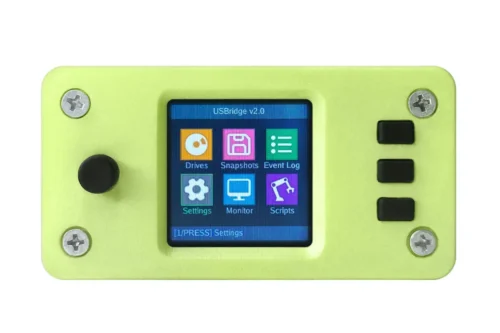
USBridge Technologies has launched a crowdfunding campaign for the USBridge-KVM 2.0 through Crowd Supply, an open-source hardware IP-KVM device that allows engineers to remotely access a computer’s display, keyboard and mouse, even when the system has crashed or cannot boot normally. It provides a lower-cost way to perform remote troubleshooting without relying on built-in enterprise server-management hardware.
The USBridge-KVM 2.0 uses a Radxa Zero 3W single-board computer with an external USB HDMI capture dongle to receive the target computer’s display at up to 1080p using the UVC standard. A 240 × 240-pixel IPS display provides local status information, while dual-band Wi-Fi sends video and input data to another device through Moonlight, a low-latency streaming protocol, with a claimed latency of 25 to 50 ms at 720p and 50 to 75 ms at 1080p. Two USB Type-C ports and a power-management module allow the target computer to be remotely switched on or off. The device also includes a Micro HDMI pass-through output and a MicroSD card slot.
The standout feature is BIOS-in-Terminal, which uses offline optical character recognition (OCR) to read the target computer’s BIOS and pre-boot screens and convert them into plain text accessible over Secure Shell (SSH). This allows engineers to troubleshoot a computer that is stuck before the operating system loads without opening a remote desktop session. The $219 kit includes the KVM unit in a selective laser-sintered (SLS) nylon enclosure, a USB HDMI capture dongle, a power-management module with jumper wires, a USB-C cable and a pre-loaded MicroSD card. Crowd Supply lists worldwide shipping, but does not provide an India-specific breakdown of customs duty or GST, so the final landed cost in India cannot be confirmed from the listing.
Enterprise servers usually include dedicated remote-management hardware, such as a Baseboard Management Controller (BMC), which can provide access to the system even when the operating system is not running. Desktop PCs and small servers generally do not have this capability, so troubleshooting an unresponsive machine often requires someone to be physically present. The USBridge-KVM brings similar remote access to computers with HDMI and USB ports, allowing engineers to view BIOS screens, control the system and remotely cycle its power without dedicated server-management hardware.
The USBridge-KVM 2.0 is an open-source hardware project being crowdfunded through Crowd Supply rather than a mass-manufactured commercial appliance. The $219 kit is expected to begin shipping from 21 March 2027, with worldwide shipping included. Buyers should therefore expect a small-batch maker product rather than the established support and service structure of an enterprise remote-management system. The BIOS-in-Terminal feature processes OCR locally, but its accuracy across different motherboard BIOS vendors, fonts and layouts has not been independently verified.
Indian small and mid-sized businesses running local servers or branch-office PCs across multiple locations may not be able to justify having dedicated IT staff at every site. Enterprise remote-management hardware is usually aimed at larger server deployments, leaving smaller businesses, home-lab users and small hosting operators with fewer options. An open-source device costing less than $250 could provide a practical way to remotely troubleshoot ordinary PCs and small servers without the cost and complexity of enterprise-grade out-of-band management.
By putting BIOS-level remote access into an open-source board that can be built or purchased, the USBridge-KVM brings a capability once associated with expensive server hardware to ordinary desktop PCs and small servers.
For more information, click here.

