




3D-printed blocks maintain electrical connections as structures change shape, enabling devices to detect configurations without external wires or external controllers.
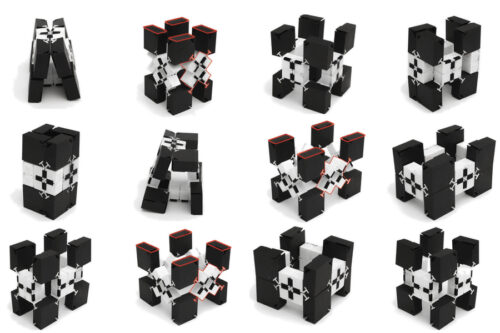
Shape-changing devices could be designed using a 3D-printed modular structure that maintains electrical connections as it changes form. Researchers at MIT and collaborating universities developed the system using modular blocks called “bifur-circuits,” which can be connected and rotated into different configurations while built-in conductive paths maintain connectivity.
The system can detect its configuration and send that information to an electronic system without external wires. Possible applications include robotic grippers, rehabilitation equipment, interactive furniture, and reconfigurable antennas.
The researchers demonstrated the concept with a chair that could transform into a table with storage and flatten for storage. It detected its configuration and sent the information to a display. They also built a controller that selected video games based on its shape.
The bifur-circuits use mechanical metamaterials based on repeating geometric units. The team uses auxetic structures, which expand sideways when stretched. Earlier work used similar structures to build antennas with three shapes, each operating at a different frequency range. The new design allows more configurations by connecting and rotating blocks, with the number increasing as more blocks are added.
The system uses mechanical bifurcation, where a structure switches between stable states when a force reaches a critical point, similar to a plastic ruler suddenly buckling when bent. In bifur-circuits, blocks move around pivot points and settle into different positions.
Conductive material inside the blocks creates different electrical paths as the blocks are connected and rotated. These circuits reveal how the components are arranged, allowing the physical shape to carry information.
Keeping the conductive paths working while the structure bends was a key design challenge. The researchers compressed the structures more than 10,000 times without degradation in electrical connectivity.
They also developed software to design and simulate bifur-circuit structures and generate fabrication instructions for a multimaterial 3D printer, allowing mechanical and conductive elements to be produced together.
The approach could also enable antennas to change operating frequency and sensing or communication characteristics by changing shape. Other uses include rehabilitation devices, adaptive robotic grippers, and deployable structures. The researchers plan to test other metamaterial geometries and add more interactive functions.


