




How do photonic chips move beyond the laboratory? A new facility in Queensland will help researchers package and test them for practical applications.
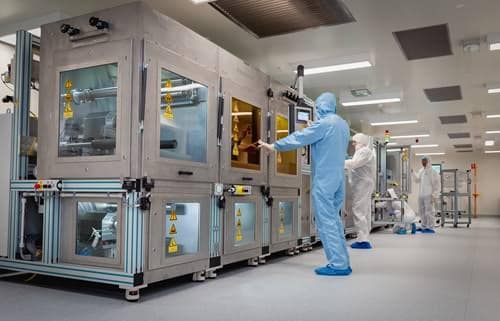
CSIRO has opened the Queensland Advanced Photonics Packaging Centre (Q-APP) in Brisbane, Australia, to package, connect, and test photonic integrated circuits (PICs) for applications including sensing, high-speed communications, quantum systems, and advanced manufacturing.

Photonic chips use light to carry and process information, but turning them into usable devices requires more than fabricating the chip itself. Optical fibres, lasers, electrical connections, thermal management, and protective packaging must be integrated and tested before the technology can operate reliably outside a laboratory.
The facility provides infrastructure for prototype and pilot-scale photonic chip packaging, covering electrical, optical, and thermal integration. Its capabilities include fibre-array attachment, laser-to-chip integration, and micro-optic fabrication using two-photon polymerisation lithography.The infrastructure is expected to support applications in communications, sensing, defence, resources, advanced manufacturing, and quantum technologies.
Fibre-array attachment allows multiple optical fibres to be aligned and connected with a photonic chip, while laser-to-chip integration enables light sources to be coupled with photonic circuits. Thermal management addresses heat generated within the packaged device and helps maintain reliable operation.
The facility’s micro-optic fabrication capability uses two-photon polymerisation lithography to produce small optical structures that can be integrated with photonic systems. These components can help manage and direct light within the packaged device.
Packaging is a critical stage in photonics because a functioning chip still needs reliable interfaces with the outside world. Optical alignment, electrical connections, thermal behaviour, and mechanical protection all have to be addressed in a form suitable for practical deployment.
The facility is primarily funded through the Queensland Government’s Quantum and Advanced Technologies Commercialisation Infrastructure Program, which aims to provide infrastructure for testing and commercialising emerging technologies.
The centre therefore focuses on a key engineering step in photonics: taking a small light-based chip that works in the laboratory and integrating it into a reliable device capable of operating in real-world conditions.

