




Researchers propose reasoning-led wireless networks where AI agents interpret intent, prioritise information and coordinate communication to support future autonomous systems across connected environments at scale.
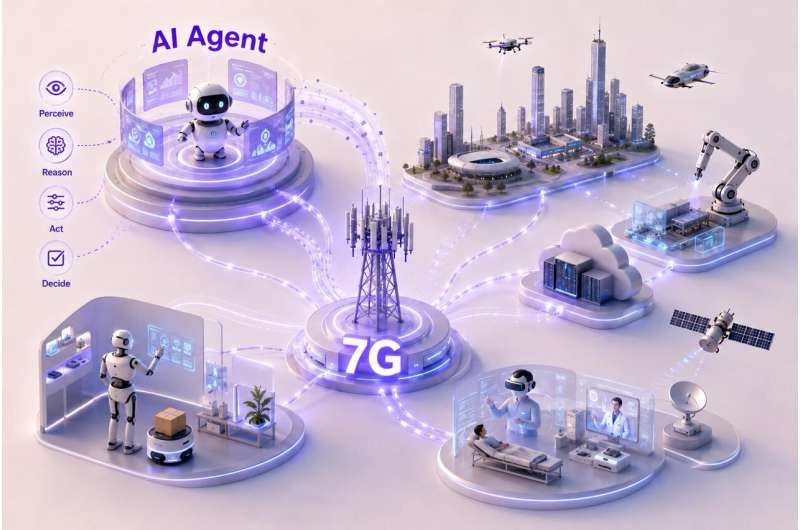
AI agent networks concept: autonomous AI agents collaborate across smart cities, healthcare systems, industrial environments and digital worlds.
Researchers at the Hong Kong University of Science and Technology (HKUST) have proposed a Reasoning-Empowered Task-Oriented Communication (TOC) framework as a roadmap towards agentic 7G wireless networks. The research explores how future networks could move beyond simply transporting data and instead use intelligence to determine what information matters, who needs it and when it should be communicated.
The study argues that existing communication systems could become a bottleneck as autonomous vehicles, smart cities, healthcare platforms and industrial systems involve millions of intelligent agents exchanging information simultaneously. Simply increasing network capacity may not be enough to support these increasingly complex ecosystems.
The proposed approach integrates reasoning directly into the communication process. Before transmitting information, an AI agent could evaluate the value of an exchange, identify relevant recipients and anticipate how the message might influence future decisions.
The framework centres on three capabilities. Intent interpretation converts a high-level objective, such as maintaining a stable video call, into a structured communication goal. Automated formulation and optimisation then selects an appropriate strategy while balancing bandwidth, power, latency and robustness as conditions change.
A third capability, proactive foresight, uses a world model to anticipate changes in the environment, user mobility and task requirements before network performance deteriorates. Together, these functions are intended to create a feedback loop in which cognition guides communication while communication strengthens collective intelligence.
Potential applications include vehicles and roadside systems exchanging information to avoid hazards, clinical agents prioritising time-sensitive signals, and machines coordinating maintenance before production faults occur.
The researchers emphasise that the roadmap is not a finished technical standard. Key challenges remain, including scalable multi-agent coordination, reliable communication-reasoning loops, trustworthy AI decision-making and common benchmarks for evaluating future 7G systems.
