




A new speaker uses metamaterials and ultrasound to beam audio towards individual listeners, reducing sound leakage while enabling personalised listening in shared spaces without headphones.
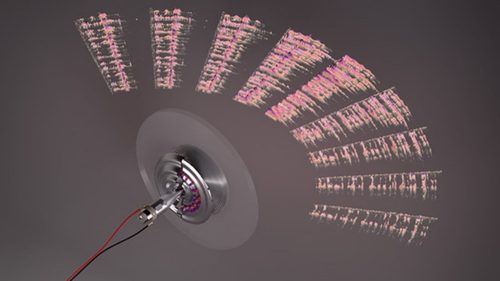
Researchers at Pohang University of Science and Technology (POSTECH) have developed a highly directional single-element speaker that can beam audio towards an individual listener while reducing unwanted sound leakage. The technology combines acoustic and elastic metamaterials with an ultrasonic transducer, creating a compact approach to personalised audio in shared environments.
Conventional parametric array loudspeakers can require complex and expensive arrangements containing hundreds of emitters to focus sound. Simpler single-element designs can struggle because unwanted vibrations allow audio to spread sideways. The new system addresses these limitations by co-designing the metamaterial structures and ultrasonic device as one integrated system.
The speaker uses ultrasound to modulate audible signals, exploiting the nonlinear behaviour of sound in air to produce a narrow audio beam. This allows sound to be directed towards a specific person, similar to shining a beam of light at a target.
A dual-material structure provides additional control. An acoustic metasurface at the front acts as a lens that shapes ultrasonic waves into a narrow beam, while elastic metamaterial units suppress vibrations that could otherwise cause lateral sound leakage. The device is designed to operate across a broad audible range of about 500 Hz to 10 kHz.
Tests using real broadcast and music signals showed that adding the elastic meta-units significantly improved directional control, allowing isolated audio delivery without disturbing nearby seats. The modular metamaterial structures can also be produced using 3D printing, supporting rapid customisation for different seat layouts, beam angles and operating conditions.
The researchers see potential applications in aircraft and train seating, where passengers could receive individual entertainment without headphones. Museums and other public venues could similarly deliver tailored commentary to visitors standing near specific exhibits, potentially creating more private and flexible listening experiences.
