

Controllers, communication, motors and sensors usually have their own place in an automation system. What happens when they start coming together?
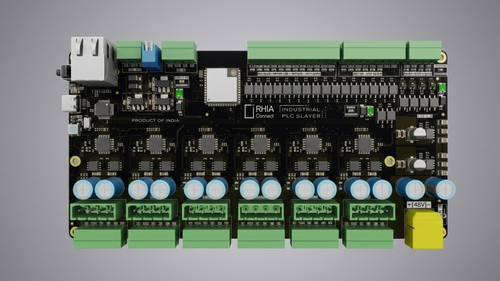
RHIA, a company working across embedded systems, internet of things (IoT) and industrial automation, is developing technologies aimed at addressing some of the practical challenges involved in building specialised automation systems. Among its key developments is PLC Slayer, a compact and customisable platform designed to bring controllers, industrial communication, I/O and motor-control capabilities together.
In an exclusive interaction with Electronics For You, Praveen Olekar, senior business development manager at RHIA, explained how the company’s engineering journey and experience with real-world automation projects eventually led to the development of PLC Slayer.
RHIA began its journey around late 2023 and was formally registered in 2024. Its early work included projects for Freshot, a company developing automated food-preparation and food-robot systems. These projects exposed the team to challenges involving hardware development, component availability and the integration of multiple systems, while also providing a real-world environment for developing and testing RHIA’s automation capabilities.
These experiences led the company to explore a more integrated approach to industrial automation. Conventional setups can require separate controllers, input/output (I/O) modules, motor drivers and communication interfaces. PLC Slayer emerged as RHIA’s response, bringing multiple functions together on a PCB-based platform that can be customised according to application requirements.
RHIA is currently developing the third generation of PLC Slayer. Compared with earlier versions, the latest design incorporates additional features, a smaller form factor and DIN rail mounting capability for installation inside industrial control panels.
The platform supports industrial communication interfaces, including controller area network (CAN) and RS485, while integrating sensors, I/O and motor-control functions. Stepper motor control also allows it to be adapted for conveyors and other motion-based automation applications.
“One of the key objectives was to create a platform that could be customised for different requirements rather than being restricted to a conventional PLC environment,” said Olekar.
The platform is now attracting interest across applications including vending machines and smart water automation systems.
RHIA is also exploring approaches that could reduce dependence on traditional programmable logic controller (PLC) development workflows. The company is working towards a system capable of identifying connected hardware and adapting its software behaviour according to application requirements, reducing the need for users to begin every project through a conventional programming process.
As PLC Slayer has evolved, the company has added industrial internet of things (IIoT)-oriented capabilities, including internet connectivity and cloud monitoring, extending the platform beyond standalone machine control towards connected automation applications.
Beyond PLC Slayer, RHIA is developing industrial sensors for applications including temperature measurement, radio frequency identification (RFID)-based identification and obstacle detection. One sensor emerged from a challenge involving temperature measurement near a cooking area operating at around 300 to 400 degrees Celsius. According to the company, commercially available sensors were unable to provide the required accuracy, leading to the development of an in-house pyrometer-based sensor using RS485 communication.
RHIA is also working on custom engineering projects involving PCB design, embedded firmware, IoT and industrial electronics. One recent project involved the delivery of around 2000 printed circuit boards (PCBs) for IoT and industrial applications associated with the oil industry and DC motor-driver control.
With Version 3 of PLC Slayer under development alongside its work in sensors, embedded systems and IIoT, RHIA is building its technology around a common engineering objective: reducing the complexity of developing specialised industrial automation systems.
Looking at the company’s broader vision for industrial automation, Sharan Hiremath, Founder and CEO of RHIA, said, “We believe the future of industrial automation is not about adding more components, but about making machines simpler, smarter, and more connected. With RHIA, we are building that future from India.”