
A fluorinated carbon dot transport layer helps organic solar cells reach a certified efficiency of 19.78 per cent while retaining 85 per cent of their performance after 1800 hours at 80 per cent humidity.
Researchers led by the University of Hong Kong, working with collaborators from Shandong University of Technology, the Shanghai Institute of Optics and Fine Mechanics, the Hong Kong University of Science and Technology and City University of Hong Kong, have reported inverted organic solar cells with a certified power conversion efficiency of 19.78 per cent.
Organic solar cells use carbon-based semiconductors rather than silicon. They are thin, lightweight and can be fabricated on flexible substrates, but long-term durability remains a major challenge because charge-transport layers can degrade under moisture and mechanical stress.
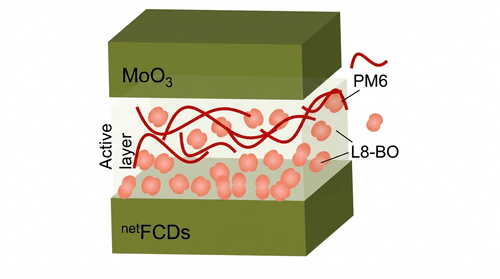
The team’s approach focuses on the electron transport layer. They incorporate fluorinated carbon dots (FCDs) into a polymer matrix to create what they call a netFCD layer. Strong hydrogen bonding between the carbon dots and polymer forms a more coherent, crystallinity-enhanced network and improves electrical and mechanical contact at both the cathode and active-layer interfaces. According to the authors, the material’s reduced basicity also helps prevent unwanted interfacial reactions with non-fullerene acceptors.
Laboratory devices reached a power conversion efficiency of 20.01 per cent, with an independently certified efficiency of 19.78 per cent. The devices retained 85 per cent of their initial efficiency after 1800 hours of operation at 80 ± 5 per cent relative humidity. Flexible versions retained 95 per cent of their initial efficiency after 10,000 bending cycles, demonstrating improved environmental and mechanical stability.
This is still behind commercial crystalline-silicon solar modules, which commonly achieve efficiencies above 20 per cent and often carry performance warranties of around 25 years. The claim here is not that organic solar cells outperform silicon, but that they can combine competitive efficiency with flexibility, printability and improved resistance to humid conditions. The retention of performance after prolonged exposure to high humidity is particularly important because moisture stability has remained a major obstacle to bringing organic photovoltaics from laboratory demonstrations into practical applications.
This remains a laboratory-scale demonstrator, with third-party certification applying to the efficiency measurement rather than to a commercial module. The team reports no pilot-scale manufacturing or module-scale result. Scaling from small laboratory cells to larger photovoltaic modules introduces additional losses and manufacturing challenges, so the reported efficiency should not be treated as module performance.
India’s humid climate makes moisture stability particularly relevant for flexible organic solar cells. The country’s flagship rooftop programme is currently PM Surya Ghar: Muft Bijli Yojana, which aims to bring rooftop solar to 10 million households.
Flexible and lightweight solar technologies could potentially expand installation options on structures where conventional glass-and-frame modules are difficult to accommodate. However, this research remains at the small-cell stage, and the reported device has not yet been demonstrated as a practical rooftop module. India’s ALMM framework regulates approved solar photovoltaic modules and cells for applicable projects, but any future organic photovoltaic product would need to meet the relevant Indian manufacturing, performance and regulatory requirements before large-scale deployment.
For more information, click here.