Today’s vehicles demand smarter power management. Discover how conductive polymer hybrid capacitors deliver lower ESR, higher ripple current capability, and longer service life for next-generation automotive electronics.
The modern car is no longer just a vehicle: it is an intelligent computing platform. As an automotive electronics designer, you have to deal with software-defined cars, electrified powertrains, ADAS, centralised computing, and AI-powered cockpits. Such innovations require high-speed processing, increased power density, and ever-changing electrical loads, making it increasingly challenging to deliver stable and clean power.
Semiconductor devices often receive most of the attention, yet passive devices play an equally important role. Capacitors stabilise voltage levels, eliminate electrical noise, smooth ripple current, and ensure reliable operation under harsh automotive conditions. However, with increasing demands for higher power, greater efficiency, and longer vehicle life, some traditional capacitor technologies are reaching their limits.
Combining two technologies in one capacitor
Conductive polymer hybrid aluminium electrolytic capacitors were developed to bridge the gap between conventional aluminium electrolytic and solid polymer capacitors.
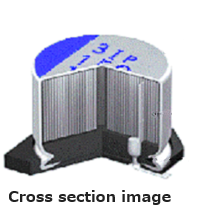
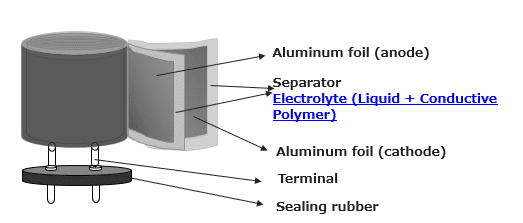
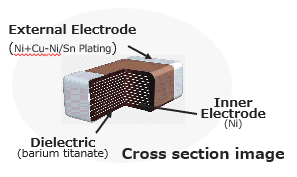
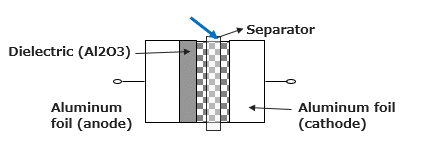
Fig. 1: Internal structure of a conductive polymer hybrid aluminium electrolytic capacitor combining aluminium oxide dielectric, aluminium electrodes, conductive polymer, and liquid electrolyte.
At first sight, the design of hybrid capacitors is quite similar to that of conventional aluminium electrolytic capacitors, in which etched aluminium foil acts as the electrode and aluminium oxide serves as the dielectric. The key difference lies in the electrolyte. Alongside the liquid electrolyte, a conductive polymer is incorporated to improve electrical performance.
The conductive polymer significantly reduces ESR, improving high-frequency performance and ripple current handling. Meanwhile, the liquid electrolyte supports higher voltage ratings, enhances stability, and provides self-healing capability.
Engineering advantages beyond lower ESR
Lower ESR does more than cut resistive loss: less self-heating means higher allowable ripple current and longer service life.
In many applications, the improved electrical performance allows fewer hybrid capacitors to replace multiple conventional capacitors. Benchmarking results from TAIYO YUDEN show that, within the same package type, hybrid capacitors offer lower ESR, higher ripple current ratings, and longer service life than aluminium electrolytic capacitors.
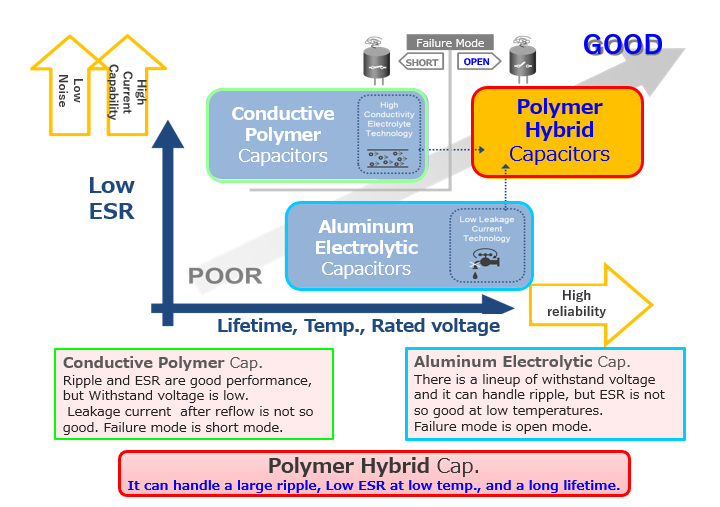
The performance difference becomes clear when comparing hybrid capacitors with conventional aluminium electrolytic capacitors. The same 25 V, 330 μF package can increase ripple current capability from 500 mArms to 2,000 mArms, reduce ESR from 0.15 Ω to 0.02 Ω, and extend operational life from 2,000 to 4,000 hours at 125°C. For applications requiring even longer endurance, 6,000-hour and 8,000-hour options are available in the HVK-B and HVL series. This enables better electrical performance while reducing the number of capacitors required.
The advantages extend to real-world operating conditions. Unlike standard aluminium electrolytic capacitors, which exhibit significantly higher ESR at low temperatures, hybrid capacitors maintain low, stable ESR across a wide range of temperatures and frequencies, allowing them to provide reliable filtering during cold-start conditions and at elevated temperatures. In addition, they exhibit more stable leakage current characteristics following reflow soldering without requiring the additional voltage ageing needed for conductive polymer capacitors. In terms of reliability, hybrid capacitors are designed to fail in an open-circuit mode, and automotive-grade devices can withstand vibrations of up to 30G.
Enabling the shift to 48V automotive electronics
As vehicles transition from distributed ECUs to centralised computing architectures, power electronics must handle increasingly demanding operating conditions. Processors, AI chips, sensors, and electrically powered systems all require significantly more power than conventional 12V systems can provide. This is driving the transition to 48V electrical systems, which improve power distribution efficiency, reduce current losses, and support the growing computing demands of modern vehicles.
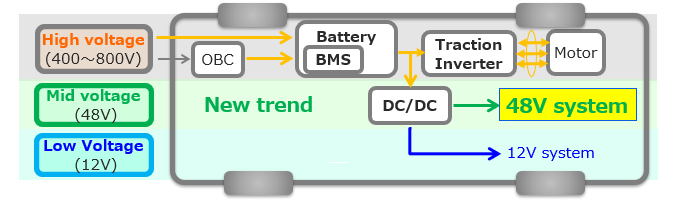
In contrast to traditional vehicles, modern SDVs have domain controllers, zonal controllers, battery management systems (BMS), onboard chargers (OBCs), DC/DC converters, and many electric motors working under varying loads. These applications require capacitors capable of handling high ripple currents, maintaining low ESR, and delivering reliable operation under demanding automotive conditions.
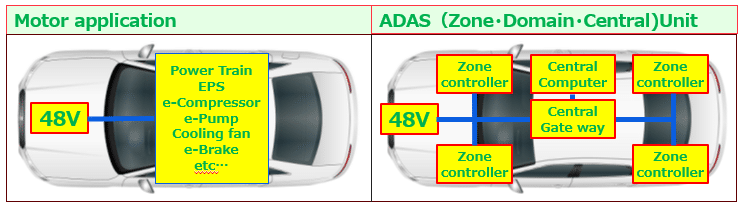
The move from 12V to 48V in automotive is not only for more power delivery. Higher system voltage allows the same power to be delivered at lower current levels, resulting in smaller cables, reduced conduction losses, and improved overall efficiency. However, the transition also introduces challenges, such as larger voltage transients, which capacitors must withstand without compromising reliability.
Supporting high-power automotive applications
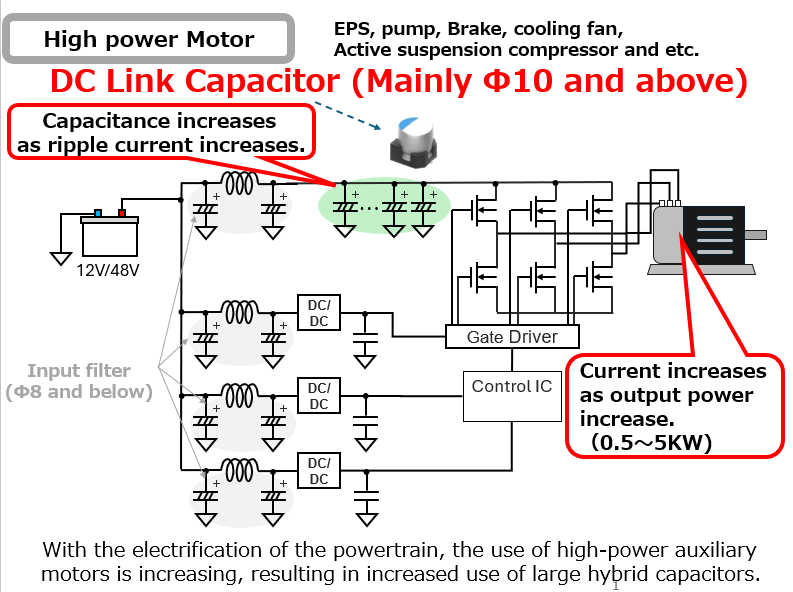
Electrification extends well beyond the traction motor. Many functions that were previously performed mechanically, such as electric power steering (EPS), water and oil pumps, cooling fans, air-conditioning compressors, active suspension, and brake actuators, now operate under fluctuating loads. These applications require capacitors with higher capacitance, lower ESR, and high ripple current capability. Hybrid capacitors, particularly large-case variants, are well suited to meeting these requirements.
In the domain of high-performance automotive computing, domain controllers, zonal controllers, central gateways, and AI computers need to process data from numerous sensors while supplying power to fast processors and memory at fluctuating current levels. To maintain stable power rails, these systems require capacitors with extremely low ESR. Hybrid capacitors meet these requirements without increasing printed circuit board size, making them well suited to modern automotive computing platforms.
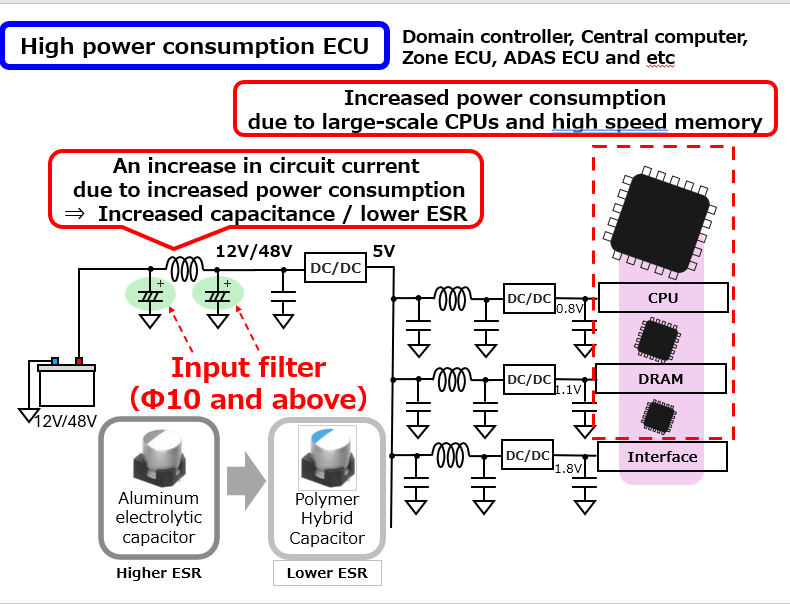
Hybrid capacitors are also suitable for traditional automotive electronics, including engine ECUs, body control modules, infotainment systems, LED headlights, radar systems, navigation modules, and motor controllers. With compact dimensions, low and stable ESR, high ripple current capability, and long operating life, they improve reliability while reducing component count. For example, replacing an aluminium electrolytic capacitor with a hybrid capacitor in an LED driver can reduce ripple output voltage by a factor of three while maintaining the same capacitance.
A portfolio built for automotive design
To support these diverse applications, TAIYO YUDEN has developed one of the industry’s broadest portfolios of conductive polymer hybrid aluminium electrolytic capacitors. The range spans 16V to 100V and capacitance values from 10µF to 1800µF, addressing everything from compact ECUs to high-power DC/DC converters and 48V systems. Click here to explore the diverse range.
Rather than relying on a single product family, the company offers specialised series optimised for different operating environments. The HV1/HT1 series delivers low ESR, high ripple-current capability, and long operational life for general automotive applications, with the HT variants incorporating an anti-vibration seat plate and dummy-terminal construction for applications requiring higher vibration resistance. The HVK/HTK, HVL/HTL, and HVY/HTY families further extend performance, with the HVL/HTL series offering rated lifetimes of up to 8,000 hours at 125°C for continuously operating high-temperature electronics, while the HVY/HTY series supports operation at up to 150°C. The portfolio has continued to evolve through the HVK, HVX, HVX-J, and latest HVX-K generations, with each generation increasing ripple-current capability and expanding capacitance and voltage options while enabling smaller package sizes for higher power-density automotive designs.
As automotive electronics move toward higher power density and more compact 48V power systems, TAIYO YUDEN continues to advance its conductive polymer hybrid aluminum electrolytic capacitor technology. The HVX-J and HTX-J Series build on the established HVX and HTX Series by improving ripple current performance while expanding the available case sizes. Representative 63V J Series products include a 150µF, 5,200mArms model in a Φ10 × 16.5mm case and a 150µF, 5,000mArms model in a low-profile Φ12.5 × 13.5mm case, the latter suited to applications requiring high current handling within tight height constraints.
The HVX-K and HTX-K Series further optimize materials and component design to increase capacitance while maintaining high ripple current capability delivering best-in-class specifications in their class. For example, a representative 63V K Series product in a Φ10 × 16.5mm case provides 220µF and 5,200mArms, compared with 150µF and 5,200mArms for the corresponding J Series product. In the Φ12.5 × 13.5mm case, the K Series reaches 180µF and 5,200mArms, versus 150µF and 5,000mArms for the J Series. The K Series also includes a 63V, Φ12.5 × 16.5mm option rated at 330µF and 6,000mArms, along with 80V options including 120µF and 4,700mArms in a Φ10 × 16.5mm case and 180µF and 5,500mArms in a Φ12.5 × 16.5mm case.
A key advantage of the lineup is its availability in larger case sizes, extending up to Φ12.5 × 16.5mm. By providing greater capacitance and ripple current capability per component, these larger packages can allow engineers to replace multiple smaller capacitors with a single higher-performance device. This can reduce component count, PCB mounting area, assembly complexity, and overall design profile—important considerations as automotive power electronics become increasingly compact while demanding higher electrical performance.
For applications exposed to severe mechanical stress and vibration, HT Series variants use a reinforced seat plate and dummy terminals to achieve vibration resistance of up to 30 G at up to 1.5 mm displacement over 10–2,000 Hz, compared with 10 G for standard-seat versions. The 30 G specification applies to HT variants only and should be confirmed against the applicable L-size limitation for the specific device. Together, the expanded case-size range, higher capacitance, strong ripple current performance, and vibration-resistant options give designers greater flexibility in developing compact, high-power automotive electronics while maintaining electrical and mechanical reliability.
Designed for tomorrow’s automotive electronics
The demand for high-performance, compact PCBs, efficiency, and reliability in automotive electronics continues to increase as electronic systems become more advanced. Conductive polymer hybrid aluminium electrolytic capacitors provide low ESR, high ripple current capability, excellent heat resistance, and long operating life. TAIYO YUDEN expands such flexibility by providing one of the most diverse hybrid capacitor lineups, from Φ5 mm × 5.8mm to Φ12.5mm × 16.5mm in size, an application-specific lineup for operation at 125°C and 150°C, high vibration environments, and compact power converters, with AEC-Q200 compliance and customised products.
The HVX(-K)/HTX(-K) series entered mass production in June 2026, is manufactured at Shirakawa Plant and ELNA’s Aomori Plant, and is available in 46 part numbers across seven case sizes.
Representative Best-in-Class Performance Specifications
| Rated Voltage | Case Size | J Series | K Series |
|---|---|---|---|
| 63V | Φ10 × 16.5mm | 150µF / 5,200mArms | 220µF / 5,200mArms / 125℃ |
| 63V | Φ12.5 × 13.5mm | 150µF / 5,000mArms | 180µF / 5,000mArms / 125℃ |
| 63V | Φ12.5 × 16.5mm | — | 330µF / 6,000mArms / 125℃ |
| 80V | Φ10 × 16.5mm | — | 120µF / 4,700mArms / 125℃ |
| 80V | Φ12.5 × 13.5mm | — | 120µF / 4,700mArms / 125℃ |
| 80V | Φ12.5 × 16.5mm | — | 180µF / 5,500mArms / 125℃ |
As automotive electronics continue evolving towards AI-enabled driving, centralised computing, zonal architectures, 48V electrical systems, and greater electrification, the demand for compact, efficient, and reliable power supplies will continue to grow. Hybrid capacitors simplify power supply design by reducing component count and PCB size while improving thermal performance and stability in demanding operating environments. By expanding voltage options, increasing ripple current capability, offering larger case sizes, and developing application-specific product families, TAIYO YUDEN supports the design of next-generation automotive electronics. To select the right capacitor for your design, explore the product selector, review the latest datasheets, and request engineering samples or technical support from TAIYO YUDEN. Where available, the surge voltage test report provides additional validation for evaluating automotive transient voltage performance.
Design challenges and solutions
| Challenge | Engineering approach |
| Increasing ripple current in high-power automotive electronics | Use low-ESR hybrid capacitors with higher ripple current capability to reduce heat generation and improve efficiency |
| PCB space constraints | Select larger-capacity hybrid capacitors or higher-performance series such as HVX-K to reduce component count and mounting area |
| Reliable operation in harsh environments | Choose AEC-Q200-qualified hybrid capacitors with vibration resistance up to 30G and high-temperature ratings of up to 150°C |
| Transition to 48V vehicle architectures | Match capacitor voltage ratings with automotive surge requirements and application conditions to optimise cost, footprint, and reliability |
| High-current AI and domain controllers | Use low-ESR hybrid capacitors with high capacitance to stabilise rapidly changing processor loads and improve power integrity |