

An organic UV sensor detects corona discharge on high-voltage equipment down to 60 nanowatts per square centimetre.
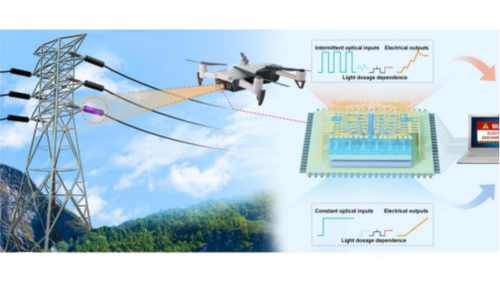
Researchers at Tianjin University and the Changchun Institute of Applied Chemistry, Chinese Academy of Sciences, have reported an organic neuromorphic sensor designed to detect corona discharge on high-voltage power equipment.
Corona discharge is a partial electrical breakdown of the air around high-voltage equipment. It can cause energy losses and damage surrounding insulation and components, making early detection important for monitoring the condition of power infrastructure.
Corona discharge emits ultraviolet light, including wavelengths in the solar-blind ultraviolet band. Because the atmosphere absorbs much of the Sun’s radiation in this band before it reaches ground level, a detector tuned to these wavelengths can identify corona emissions with very little solar background interference, even in daylight.
The Tianjin device uses an organic semiconductor film deposited by solution shearing, a potentially lower-cost fabrication method than vacuum-based semiconductor growth. The researchers also describe the sensor as neuromorphic, meaning it can combine sensing with aspects of signal storage and processing within the device rather than sending all raw optical data to a separate processor.
The sensor achieved a detection threshold of 60 nanowatts per square centimetre, with a reported photoresponsivity of 4.6 × 10⁷ amperes per watt and a specific detectivity of 2.9 × 10¹⁸ Jones. The team also reports a photosensitivity of 1.1 × 10⁷, an external quantum efficiency of 2.2 × 10⁸ per cent, and a photoresponse time of 25 milliseconds.
Beyond detecting ultraviolet light, the device demonstrated neuromorphic pattern recognition, achieving 100 per cent recognition accuracy in the reported analogue patterning task and a two-second rapid patterning mode. The researchers also report that the device retained favourable performance after one year of storage.
Field systems for detecting corona discharge can use solar-blind ultraviolet imaging technologies based on photomultiplier tubes and image intensifiers, as well as wide-bandgap semiconductor detectors. These approaches can involve specialised optical and semiconductor components, while the Tianjin team’s organic sensor is fabricated using solution shearing, a potentially lower-cost and more scalable coating process.
The neuromorphic design could also reduce the amount of data that needs to leave the sensor. Instead of continuously transmitting raw optical information to an external processor, the device can perform aspects of sensing, storage and pattern processing locally. In a future monitoring system, this could allow a sensor to transmit a detected event or warning rather than continuously sending large amounts of raw data, potentially reducing processing and communication requirements.
This is a laboratory proof-of-concept rather than a fielded instrument. The authors report proof-of-concept corona-discharge experiments, but the work does not establish long-term outdoor reliability under conditions such as temperature cycling, humidity exposure, dust or prolonged environmental ultraviolet exposure. The reported one-year stability is a storage measurement and should not be treated as equivalent to one year of field operation.
India has a large extra-high-voltage transmission network, including an extensive 765 kV system. That makes reliable corona monitoring relevant to Indian power infrastructure. A low-cost, solution-processed ultraviolet detector could potentially reduce the cost or complexity of future monitoring systems if its laboratory performance can be translated into a robust outdoor device.
The Central Power Research Institute (CPRI) in Bengaluru has high-voltage and artificial-pollution testing facilities, making it the kind of institution that could evaluate such technology under demanding electrical and environmental conditions. The important qualification, however, is that the Tianjin sensor has not yet demonstrated that level of field durability.
India’s transmission losses are measured nationally, and corona is one of the technical effects utilities seek to monitor and control. If this type of sensor can eventually be manufactured at low cost and survive outdoor conditions, it could make corona detection an interesting technology to watch for large power networks.
For more information, click here.