




A new diamond-spin quantum computer prototype integrates tin-vacancy qubits with photonic circuits, combining stable quantum states, optical connectivity, and integrated control for scalable architectures.
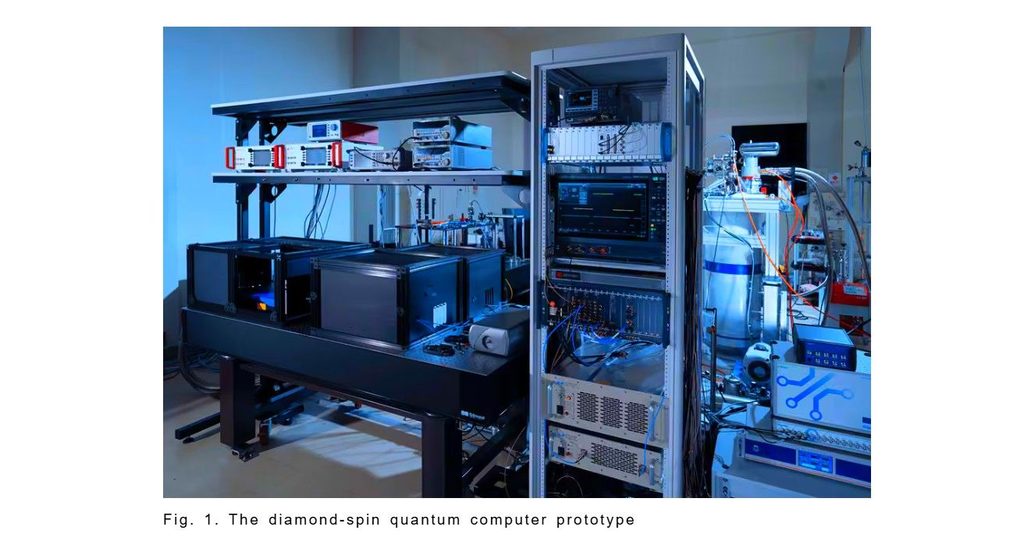
Fujitsu has developed a working diamond-spin quantum computer prototype that integrates tin-vacancy (SnV) color centers with photonic integrated circuits, offering an electronics- and photonics-based route toward modular quantum processors.
The prototype operates at -271.6°C, a temperature slightly above the operating range typically associated with superconducting quantum computers. Its significance lies less in the operating temperature than in its architecture: quantum modules can potentially be connected using optical signals, creating a pathway for scaling quantum systems while maintaining high-fidelity qubit operation.
At the heart of the design are SnV centers in diamond, which act as qubits. Diamond provides an environment where quantum states can remain relatively stable, while the structural symmetry of SnV centers makes them less vulnerable to environmental noise than conventional nitrogen-vacancy (NV) centers. SnV centers can also generate bright single photons, making them suitable for optical quantum interconnects.
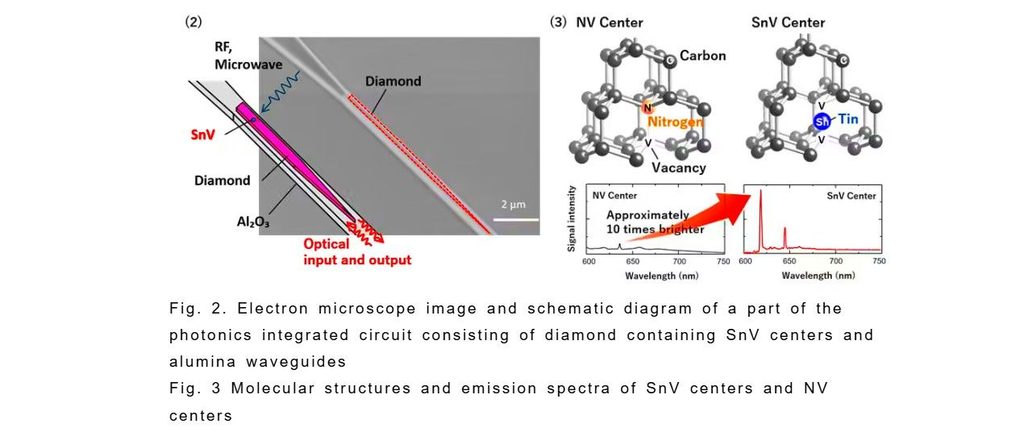
The prototype combines these color centers with photonic integrated circuits (PICs). Fujitsu developed a heterogeneous bonding process to attach diamond substrates containing implanted tin to alumina and silicon-dioxide substrates. The diamond layer is subsequently thinned from several hundred micrometers to several hundred nanometers, allowing it to be incorporated into compact quantum chips.
The photonic section integrates nanometer-scale diamond crystals containing SnV centers with alumina optical waveguides. Because the waveguides are transparent to visible light, they can capture single photons emitted by the SnV centers during qubit readout. Such optical interfaces could enable quantum information to move between separate modules without requiring every qubit to be physically located on one large processor.
The system also addresses the control complexity of diamond-spin quantum computing. Unlike architectures controlled primarily through a single electrical mechanism, diamond-spin qubits require coordinated optical, microwave, and radio-frequency signals. Fujitsu has developed a circuit-conversion mechanism that translates quantum gates into the physical control sequences required by these signals.
This control layer enables the prototype to operate through Fujitsu’s Hybrid Quantum Computing Platform, reducing the need for users to directly manage the underlying hardware controls.
The development follows collaborative research with Delft University of Technology and QuTech that began in 2020. Fujitsu plans a multi-module diamond-spin prototype by 2027 and is also exploring combining diamond-spin and superconducting technologies as part of its longer-term quantum-computing roadmap.

