





An embedded module adds AI processing, camera support, displays, networking, security, and real-time control for industrial devices.
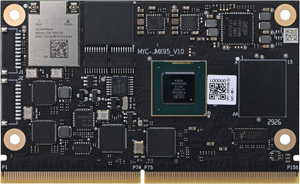
MYIR Electronics has introduced the MYC-JMX95X, a SMARC System-on-Module (SOM) based on the NXP i.MX95 processor. The module is designed for industrial automation, edge AI gateways, machine vision, power systems, medical devices, and in-vehicle infotainment.
The module combines six Arm Cortex-A55 cores, a Cortex-M7 real-time core, a Cortex-M33 security core, a 2 TOPS NPU, and an Arm Mali-G310 GPU. It supports 4K video processing, multi-display output, camera connectivity, and high-speed networking. Developers can use it to add AI processing, real-time control, camera input, networking, and display functions to embedded systems.
For display and camera applications, the module provides one MIPI-DSI interface, two LVDS interfaces, and a four-lane MIPI-CSI interface. HDMI output up to 4K at 30 Hz is available through a carrier board.
The module also provides two CAN FD interfaces, four UARTs, two SPI interfaces, two SAI interfaces for I2S/PCM/TDM, three I2C interfaces, SD/SDIO 3.0, PWM, and ADC for control and peripheral connections.
Security features include an independent TPM 2.0 chip, TrustZone hardware isolation, Secure Boot, and support for AES, RSA, and ECC. The security architecture also supports post-quantum cryptography (PQC) and is aligned with the requirements of the EU Cyber Resilience Act (CRA).
For evaluation and prototyping, MYIR provides the MYD-JMX95X development board. It combines the SOM with the MYB-JMX95X carrier board through the SMARC interface.
The development board adds 4G/5G cellular connectivity through a mini-PCIe socket with two Micro SIM slots. It also provides HDMI, MIPI-DSI, dual LVDS, MIPI-CSI camera input, and audio I/O.
Storage options include an M.2-2280 PCIe slot for NVMe SSDs and a Micro SD card slot. USB connectivity consists of two USB 3.0 Host ports, two USB 2.0 Host ports, and one USB 2.0 OTG port.
For industrial communication, the board provides dual CAN FD and RS485/RS232 through a single Phoenix connector. The carrier board can also serve as a reference baseboard design, allowing developers to use the same hardware approach during evaluation, prototyping, and production.
Click here for the original announcement.


