





Quantum computers are being tested with atoms to find ways to use fewer qubits and make different quantum machines easier to use.
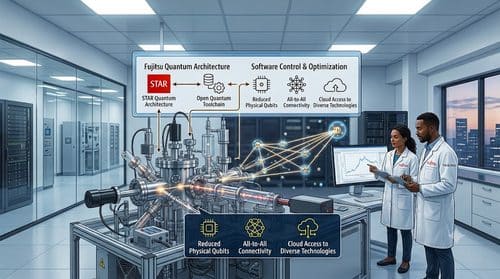
Fujitsu and Yaqumo have started testing Fujitsu’s STAR quantum computing architecture and software on working neutral-atom quantum computers. The work will show how the architecture performs on Yaqumo’s hardware and whether it can use the features of neutral-atom systems.
Fujitsu will also connect its Open Quantum Toolchain for OPerators and Users, an open-source platform for setting up, operating, and managing quantum computers through cloud services. The software will be adapted to support Yaqumo’s quantum computers and their control methods.
Neutral-atom quantum computers use atoms as qubits and can provide all-to-all connectivity. This allows qubits to interact with many other qubits without the connectivity limits found in some superconducting systems. It could also help with quantum error correction.
Fujitsu originally developed STAR mainly for superconducting quantum computers for the Early-FTQC (Fault-Tolerant Quantum Computer) era. The architecture is designed to reduce the number of qubits needed for certain computations. Its performance, however, depends on the hardware platform.
The testing will examine whether STAR can provide similar benefits on neutral-atom hardware and whether its connectivity can be used to perform computations with fewer physical qubits.
The software work will address differences in how quantum computers are controlled. The adapted toolchain will support functions such as command conversion, job management, device monitoring, and calibration for the neutral-atom system. Users will be able to access Yaqumo’s machines through the cloud.
The longer-term aim is to support a common interface that can work across different quantum computing technologies.
Yaqumo is developing quantum computers based on ytterbium neutral atoms. It aims to build a system with more than several hundred qubits and quantum error correction capabilities by fiscal year 2027.
If the tests are successful, the work could provide a way to use neutral-atom hardware for computations while reducing the number of physical qubits required. The software integration could also simplify access to quantum computers based on different technologies.


