

A steerable radiative-cooling emitter delivers 135 per cent more cooling power than the same emitter in a fixed configuration, while dynamically adjusting its exposure to the sky and sunlight.
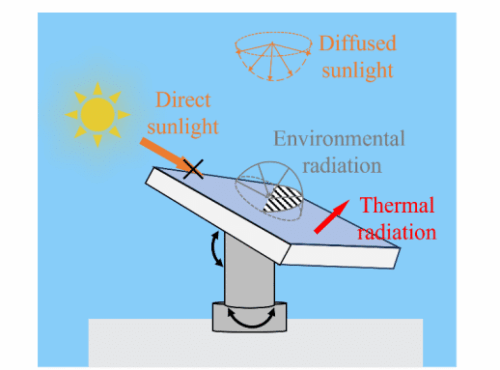
Researchers has developed a cooling system that dynamically changes the angle of a radiative emitter, inspired by the way a sunflower follows the sun. The work, titled Round-the-Clock Sub-Ambient Cooling via Dynamic Sky View Factor Steering, was developed by Qiuyu Chen, Minghao Dong, Zheng Zhang, Xiaodong Zhao, Peng Xiao and Zhen Chen.
The system, called dynamic sky view factor steering (DSVFS), addresses a limitation of conventional passive radiative cooling systems. Many such systems use a fixed, horizontal emitter that cannot adapt to changing environmental conditions such as the sun’s position and cloud coverage. DSVFS instead dynamically steers the emitter towards an optimal angle, allowing its exposure to the sky and direct sunlight to change throughout the day and night.
Passive daytime radiative cooling works by emitting heat as infrared radiation through the atmospheric window, a range of wavelengths that passes through the atmosphere with relatively low absorption. The radiation can escape towards space, allowing the surface to cool. During the day, however, the same surface must also reflect incoming sunlight; otherwise, solar absorption can exceed the heat released through thermal radiation.
This creates a demanding materials requirement. Radiative-cooling surfaces generally need very high solar reflectivity and high infrared emissivity at the same time. Designing a coating that provides both properties over the required wavelength ranges can increase material and manufacturing complexity.
DSVFS approaches the problem through geometry rather than relying entirely on the optical properties of the coating. By changing the emitter’s orientation throughout the day, the system controls its view of the sky while limiting direct solar exposure. According to the researchers, this dynamic control relaxes the stringent optical requirements placed on the cooling material, allowing less sophisticated emitters to achieve useful cooling performance.
The team reports experimental results rather than relying on simulations alone. Using a near-blackbody emitter, which has relatively high solar absorption, the researchers demonstrated sub-ambient cooling during a typical hot noon. Achieving cooling below ambient temperature under these conditions is significant because the emitter receives substantial solar radiation while attempting to reject heat through thermal radiation.
With a selective emitter, the DSVFS system delivered a 135 per cent increase in cooling power compared with the same emitter held in a static configuration. The researchers also conducted case studies across multiple cities and calculated maximum annual electricity savings of up to 200 kilowatt-hours per square metre (kWh/m²). This figure represents estimated savings relative to conventional cooling rather than electricity consumed by the radiative-cooling system itself.
The comparison is particularly relevant for India, where air conditioning represents a significant and growing electricity demand. A conventional air conditioner uses electricity to drive a refrigeration cycle and remove heat from an indoor space, while a radiative-cooling surface can reject heat directly towards the sky without a compressor or refrigerant.
Passive radiative cooling is therefore not a direct replacement for an air conditioner in every application. Instead, it can reduce the amount of heat that a building or cooling system needs to remove, potentially lowering its operating energy demand. The reported annual saving of up to 200 kWh/m² should consequently be viewed as a potential reduction in cooling-related electricity demand rather than as the output of the cooling surface itself.
The work remains at the research-demonstrator stage and is presented as a preprint rather than a peer-reviewed study. Unlike a conventional fixed radiative-cooling surface, DSVFS introduces a mechanically steerable emitter, adding system-level complexity to the cooling architecture. Practical performance will therefore depend not only on the radiative properties of the emitter but also on the implementation of the steering mechanism and its control system.
The main contribution is the use of geometry to reduce the demanding optical requirements traditionally placed on radiative-cooling materials. By dynamically controlling the emitter’s view of the sky and exposure to direct sunlight, the researchers show that less optically sophisticated emitter materials can still achieve useful cooling performance. The approach could provide a route towards lower-cost radiative-cooling systems, although further work is needed to establish performance under long-term real-world operating conditions.
India provides a relevant market context because rising cooling demand is expected to place increasing pressure on the country’s electricity system. Indian research groups are also active in radiative cooling, including work on passive cooling surfaces that operate without conventional refrigeration.
A steered emitter could, however, face additional challenges in Indian conditions that are not tested in this study. Dust accumulation is one consideration because deposits on an outdoor radiative-cooling surface can alter its optical properties and reduce cooling performance, potentially creating a need for periodic cleaning. Haze is another concern. Aerosols and pollutants can reduce atmospheric transmission within the infrared wavelengths used for radiative cooling, limiting the heat that can escape through the atmospheric window. Published research on haze-affected radiative cooling has shown that atmospheric pollution can significantly influence cooling performance.
These factors would need to be considered when evaluating DSVFS in real-world Indian environments, particularly for long-term rooftop installations.
For more information, click here.