


A current sensor enables power monitoring in electric vehicles, converters, and solar inverters for electrification applications.
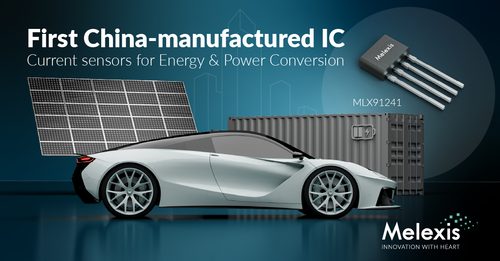
Melexis has introduced the MLX91241, a high-speed Hall-effect current sensor IC produced through a localised manufacturing model in China. The launch marks the company’s first integrated circuit (IC) manufactured under its China localisation strategy.

China is a major market for electric vehicles (EVs), power conversion, and renewable energy systems. Melexis says its local manufacturing approach is intended to support customers in the region with shorter development cycles, cost-optimised products, and more consistent supply by aligning production with local supply chains.
The company has selected current sensing as the first product area for local production, reflecting the growing demand for current monitoring in high-power electrification applications. Current sensing is used to monitor and control power flow in systems such as EV powertrains, energy conversion equipment, and renewable energy platforms.
The MLX91241 uses conventional Hall-effect sensing to measure current at high speed. The sensor is designed for applications including EV traction inverters, 48 V boost recuperation systems, DC-DC converters, and solar inverters.
The device brings Melexis’ magnetic sensing technology to a locally produced, cost-optimised package for applications that require high-speed current monitoring. Its China-based production is also intended to support the company’s broader localisation strategy for the country’s electrification market.
“The MLX91241 puts silicon on the table and demonstrates our long-term commitment to the Chinese market,” said Bruno Boury, Product Line Director at Melexis. “Starting with current sensing was a natural choice given China’s leadership in EV and energy applications. This launch demonstrates our localised strategy is fully operational, bringing regional supply-chain alignment without compromising on the quality discipline our customers expect. And this is just the first of more locally produced silicon to come.”
Click here for the original announcement.