




A battery-free neuromorphic device combines tactile sensing, memory, and learning in flexible electronics, pointing toward low-power wearables that can process movement signals locally.
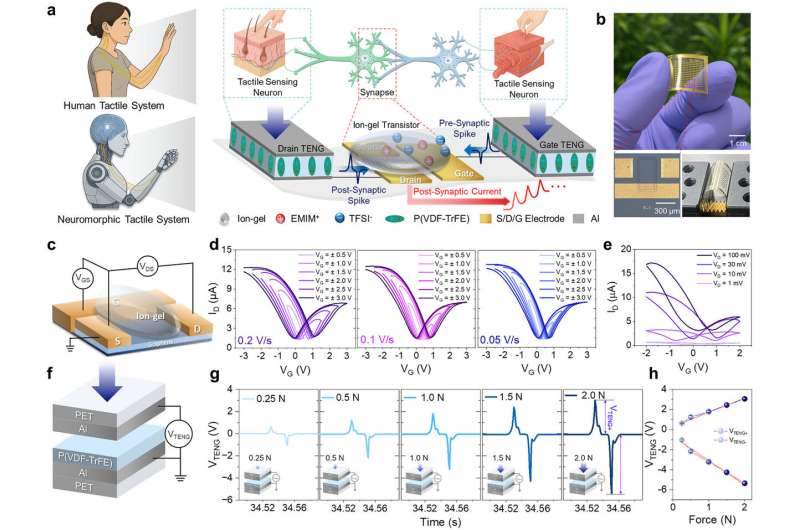
Researchers at Dongguk University, South Korea, have developed a self-powered artificial synapse that combines sensing, memory, and learning in a flexible electronic device. The architecture eliminates the need for an external power source by using mechanical motion itself to generate the electrical signals required for neuromorphic processing.
At the heart of the device is a graphene-channel ion-gel-gated transistor (g-IGT) integrated with triboelectric nanogenerators (TENGs). TENGs convert mechanical inputs such as touch, vibration, or body movement into electrical pulses. Two TENGs are connected to the transistor to emulate the pre- and post-synaptic signals found in biological neural systems. This allows physical movement to directly drive artificial synaptic responses without batteries.
A key advantage is that the transistor does not simply detect an input; it can retain and adapt to stimulation history. The researchers demonstrated multiple levels of memory behaviour. Sensory memory decayed in about 70 milliseconds, while short-term memory lasted approximately 0.2–0.45 seconds. Repeated stimulation could progressively shift the response toward long-term memory, with decay extending beyond 2 seconds.
The device also demonstrates spike-rate-dependent plasticity (SRDP), allowing synaptic strength to change according to the frequency of incoming pulses. Importantly for flexible electronics, this learning behaviour remained stable when the device was bent.
The researchers tested the experimentally measured synaptic behaviour in a single-layer neural network for human-activity recognition. Using motion datasets, the system identified six activities—including walking, sitting, standing and climbing stairs—with 88.05% accuracy while the device was bent. Even under high-noise conditions, accuracy remained above 75%.
The approach could therefore shift some sensing and processing closer to the physical interface instead of continuously transferring raw sensor data to conventional processors.
Potential applications include battery-free wearable sensors, electronic skin, smart prosthetics, human-machine interfaces and motion-monitoring systems. The research points toward flexible electronics in which sensing, energy harvesting, memory and neuromorphic computation are integrated into a single hardware platform.
