





A new tri-fold smartphone combines a 10.2-inch expandable display with 3D chip integration, aiming to improve performance, power efficiency, privacy, and mobile productivity.
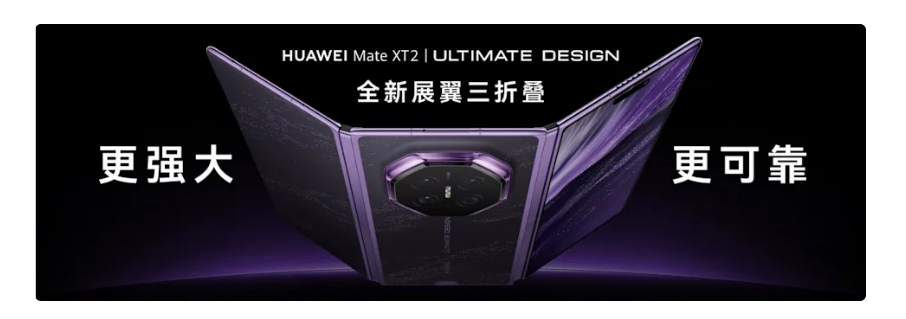
Huawei’s HUAWEI Mate XT 2 | ULTIMATE DESIGN brings together a large tri-fold display, a thin form factor, and a new approach to semiconductor integration. The smartphone is the first device to use Huawei’s Kirin 9050 Pro with its LogicFolding Tau (τ) chip design, while also being the first smartphone to run HarmonyOS 7.
The standout hardware feature is the tri-fold display, which expands the handset into a tablet-like 10.2-inch screen. When fully unfolded, the device measures just 3.5mm thick, addressing one of the major challenges of combining a large display with smartphone portability. The cover display measures 6.5 inches and delivers a 92.8% screen-to-body ratio, while improved anti-reflection helps maintain visibility under different lighting conditions.
The display also incorporates a Smart Shield Privacy Screen, designed specifically for foldable devices. Two independent pixel sets are integrated into the display at a 9μm micro-pitch. Privacy Mode narrows the viewing angle while retaining the same resolution, allowing users to work with sensitive information in public environments.
At the silicon level, the Kirin 9050 Pro introduces Huawei’s LogicFolding approach to 3D chip integration. Instead of relying primarily on geometric transistor scaling, the architecture stacks active transistor structures to shorten the distance through which data has to travel. Huawei reports that transistor density rises from about 155 million to 238 million transistors per square millimetre.
The key features are:
- 3.5mm thickness when fully unfolded
- 238 million/mm² reported transistor density
- 9μm micro-pitch privacy display architecture
- 30-second ECG signal acquisition
- 42% claimed performance improvement over predecessor
The approach targets one of the major power bottlenecks in modern processors: data movement. Shorter interconnect distances can reduce the energy required to transfer data between processing elements. This becomes increasingly important as mobile processors handle more demanding workloads while operating within tight thermal and battery constraints.
The smartphone is also the first to ship with HarmonyOS 7, with Huawei claiming a 42% performance increase over the previous generation. Its tri-fold design further enables an ECG function, allowing users to record a 30-second ECG signal by holding both side frames while the phone is unfolded. Medically certified analysis software can identify conditions including sinus rhythm, atrial fibrillation, and premature beats. The Mate XT 2 therefore combines advances in mechanical design, display technology, semiconductor integration, operating-system capabilities, and health sensing in a single foldable platform.
