





A top-side cooled resistor helps designers manage heat, handle power, and reduce PCB space in automotive circuits.
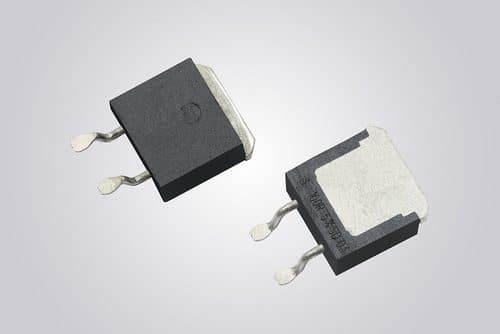
Vishay Intertechnology has introduced the Vishay Sfernice D2TO35S, an automotive-grade thick-film power resistor with top-side cooling. The surface-mount resistor can dissipate up to 35 W at 25 °C in a TO-263 (D²PAK) package when used under the specified conditions.
The resistor is designed to move heat away from the PCB by transferring it directly to a heatsink mounted on its top side. With an appropriate heatsink, the D2TO35S can provide up to nine times the power dissipation of standard PCB-mounted resistors.
This approach allows automotive electronics designers to either increase power dissipation within the same board footprint or achieve the required power handling using less board space. Moving heat away from the PCB can also help lower PCB temperatures and reduce thermal stress on nearby components.
The D2TO35S uses a non-inductive design, making it suitable for circuits where signal integrity and power handling are important during fast transient conditions. It is available with resistance values from 4.7 Ω to 550 kΩ and tolerances down to ±1%.
The resistor has a thermal resistance of 4.28 °C/W and a temperature coefficient of resistance (TCR) down to ±150 ppm/°C. It operates across a temperature range of -55 °C to +175 °C.
The device is RoHS compliant and can withstand solder reflow temperatures of up to 270 °C for 10 seconds.
Automotive electronics designers can use the D2TO35S in systems where resistors need to handle higher power without transferring as much heat to the PCB. A heatsink can be added to increase power dissipation, maintain the required power handling within an existing board footprint, or reduce the space required for the resistor.
The resistor can be used in automotive circuits where thermal management, power dissipation, signal integrity, and PCB space are important design requirements. Its non-inductive construction also makes it suitable for applications exposed to fast transient conditions.
Click here for the original announcement.

