




A solar cell design controls photon emission angles to reduce energy losses and could increase photovoltaic conversion efficiency.
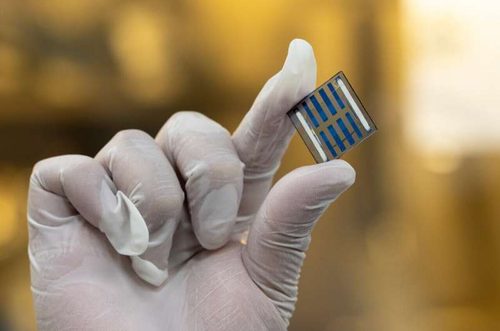
Researchers at ICFO and the Polytechnic University of Catalonia (UPC) have demonstrated a solar-cell design that reduces photon-emission losses by controlling the angles at which light leaves the cell. The approach uses an optical cavity to narrow the emission cone of an inverted organic solar cell.
The researchers say this could help photovoltaic devices move beyond the efficiency limit described by the Shockley-Queisser model. Under its assumptions, the theoretical limit for a single-junction solar cell is about 33.16%. The team estimates that matching the emission angle more closely with the angle of incoming sunlight could, in principle, enable efficiencies approaching 43%.
The cavity uses silver electrodes and a layered structure. The front silver electrode provides high reflectivity across a wide range of angles, while the surrounding layers allow incoming sunlight to reach the active material. A second silver electrode at the back of the cell works with the front electrode to form the optical cavity.
This structure changes the angular distribution of the light emitted by the solar cell. Instead of allowing photons to escape across a wide range of directions, the cavity narrows the emission cone.
The approach addresses a type of energy loss known as Boltzmann loss. Solar cells both absorb and emit light as part of the energy-conversion process. Sunlight reaches the cell from a relatively narrow range of directions because the Sun occupies a small area in the sky. The cell, however, normally emits photons across a much wider range of angles.
This mismatch between the incoming and outgoing light contributes to energy losses and limits the amount of useful electrical power that can be extracted from the cell. The researchers say the optical-cavity approach does not require additional complex fabrication steps compared with some other methods being explored to improve photovoltaic efficiency.
Although the demonstration was carried out using an organic solar cell, the researchers say the principle is not restricted to organic photovoltaic materials. It could potentially be applied to other types of solar cells.
Reducing this photon-emission loss could allow photovoltaic devices to make better use of incoming sunlight and increase power generation from a given amount of solar-cell material.

