




A method helps robots learn tasks, stay stable, follow paths, and improve tracking by up to 15% in real-world tests.
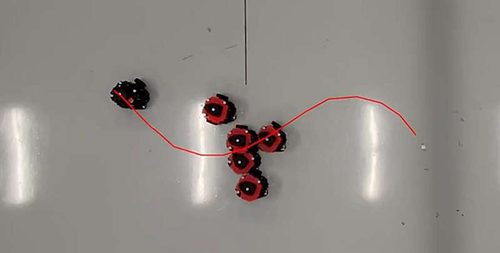
Researchers at the University of Illinois Urbana-Champaign developed a robot control method that combines reinforcement learning and control theory to maintain stability and improve tracking performance by up to 15% over existing methods. The method, called Contraction-Aware Reinforcement Learning (CARL), was tested in simulations and real-world experiments on a wheeled robot, a flapping aerial drone, and a six-legged robot.
Reinforcement learning enables robots to learn tasks through feedback on their actions. However, it does not always provide mathematical guarantees that a robot will remain stable while performing a task. This can make real-world deployment difficult, as unstable movements may damage equipment and increase repair costs.
CARL combines reinforcement learning with contraction theory to address this problem. It allows reinforcement learning to act as the robot’s main controller while providing mathematical limits on tracking errors. This helps robots follow their intended paths and reach their targets while maintaining stability.
Researchers first tested CARL in simulations before evaluating it in the aerospace engineering flight laboratory at the university. The experiments covered three robot types: the wheeled TurboBot 3 Burger, a flapping aerial drone, and the six-legged Jethexa robot.
The researchers also tested the method’s ability to handle differences between simulated models and physical robots. Such differences, known as the simulation-to-reality gap, can arise when a robot’s actual properties differ from those used during training. For example, a robot model may have a simulated mass of one kilogram, while the physical robot weighs 1.2 kilograms.
According to the researchers, CARL handled these uncertainties better than existing methods. Its tracking performance improved by up to 15% in real-world tests, with the results also showing improvements over the existing methods in simulations.
The method could be applied to robots used in wildfire management. First responders could deploy robots to locate fire hotspots or deliver supplies in areas that may be difficult or dangerous for people to access.

