

OpenAMRobot 2.0 combines two seven-degree-of-freedom robotic arms, ROS 2 navigation and an embodied AI pipeline for teaching mobile robots tasks through demonstrations.
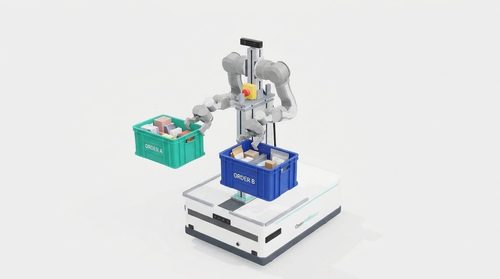
OpenAMRobot 2.0 is an open-source mobile manipulation platform designed to combine autonomous navigation, dual-arm handling and AI-based task learning. Developed by Botshare, the system is intended for applications including warehouse logistics, order picking, laboratory operations and research. Its upcoming release candidate, scheduled for 20 November 2026, is planned to include hardware designs, software and manufacturing documentation. The physical robot is undergoing integration and testing in Berlin, with a final release planned for December 2026.
The robot’s upper body uses two OpenArm 2.0 arms from Enactic, each providing seven degrees of freedom. A lift column adjusts shoulder height between 1,000mm and 1,350mm. For perception, the platform includes a stereo head camera, cameras mounted on the arms and an Orbbec Gemini 336L depth camera at the front of the mobile base. This arrangement supports navigation and manipulation tasks that require the robot to identify objects and interact with its surroundings.
An NVIDIA Jetson Orin NX serves as the high-level computer, while an STM32H723-based controller manages the mobile base through micro-ROS over Ethernet. The drivetrain uses 200mm ZLTECH hub motors with fail-safe holding brakes and a CANopen driver. Power comes from a 25.6V lithium iron phosphate battery pack with a battery management system. A safety system uses two emergency-stop buttons to disconnect motor power, while a SLAMTEC RPLIDAR S3, ultrasonic sensors, time-of-flight cliff sensors and an IMU support navigation and nearby obstacle detection.
The software stack includes ROS 2, Nav2, MoveIt 2 and ros2_control, alongside a browser-based operator interface. The embodied AI pipeline is designed around a show, correct and judge workflow: an operator demonstrates a task, intervenes when necessary and evaluates the result. The system records demonstrations and includes an Action Chunking with Transformers (ACT) imitation-learning baseline and evaluation tools. The goal is to let users teach tasks without manually programming every robot movement.
The project publishes its software under the MIT licence, documentation under CC BY 4.0 and hardware designs under CERN-OHL-P-2.0. Its repositories provide access to hardware designs, firmware, simulation, navigation software and manipulation tools. The planned release candidate is scheduled for 20 November 2026, followed by physical integration and acceptance testing through 18 December. A final release is planned for 18 December 2026.
For more information, click here.