




A stereo vision board combines two global-shutter cameras with onboard Linux processing to calculate depth for robotics applications, sending results to microcontrollers over UART.
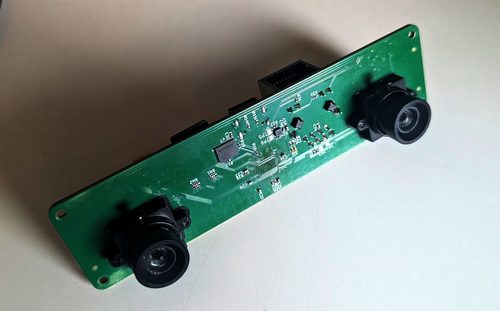
The 4reel stereo vision board, developed by hardware creator machinehum of Rootkit Labs, enables robots to calculate depth from two camera images without relying on an external computer for image processing. Built around a Rockchip RV1103 system-on-chip (SoC), the board can process stereo images locally and send results to an Arduino or ESP32 through a UART connection. This allows a host microcontroller to focus on motor control, navigation and other real-time tasks.
The board integrates two OV9281 global-shutter cameras, positioned at opposite ends of the PCB, to capture synchronised views of a scene. Its RV1103 SoC features a single Arm Cortex-A7 core operating at 1.1GHz and 64MB of DDR2 RAM. The board also includes a three-axis LIS2HH12 accelerometer, 4MB of W25Q32 flash memory, a microSD card slot and a 10/100 Ethernet port. USB-C provides connectivity for configuration and debugging, while a JST connector supports UART communication and 5V power input.
A key feature is the use of the RV1103’s hardware sum-of-absolute-differences (SAD) accelerator for stereo matching. The software captures images through the Linux Video4Linux2 (V4L2) interface and uses the accelerator to compare image regions and estimate depth. This reduces the computational work required from the processor compared with performing the matching calculations entirely in software. The board can also operate as a standalone Linux device, with a web interface available over its USB-C network connection for viewing images, calibration and focus adjustments.
The four-layer PCB design was developed for embedded vision and mobile robotics applications, including obstacle avoidance and navigation. The creator has documented the first hardware revision and its design corrections, offering insight into the development process.

Hardware design files, Buildroot configuration and supporting scripts are available on GitHub under the MIT licence. The software uses a Buildroot-based Linux system with a Rockchip vendor kernel. Simultaneous localisation and mapping (SLAM) and YOLO-based object detection are among the planned development directions; their performance on the board has not yet been established in the published material.
For more information, click here.


