Could a molecule’s rotation help control electrical current? Research involving IIT Madras demonstrates how molecular motion and electron transport can influence each other.
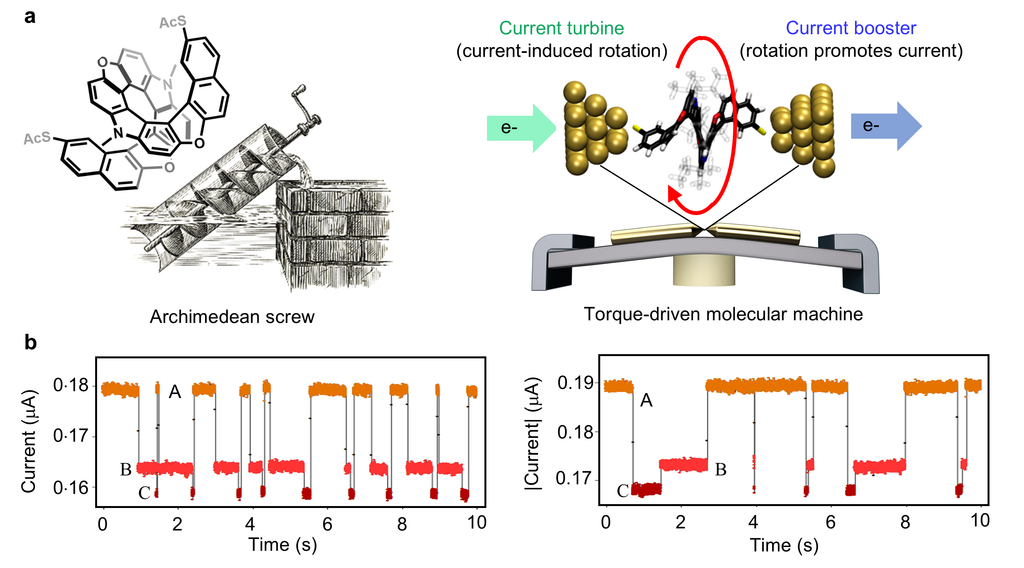
An international research team including Indian Institute of Technology Madras (IIT Madras) faculty has demonstrated how electrically driven molecular rotation can increase electrical conduction through a single molecule, offering insights for future nanoscale electronics.
The findings could inform molecular-scale switches and components that regulate current through motion. However, the work remains a proof of principle, not a technology ready for practical devices.
The researchers suspended a spiral-shaped molecule called helicene between two gold electrodes using a mechanically controllable break junction. When voltage was applied, electrical current drove the molecule through different configurations. In all 122 cases where transition directions could be determined, the team observed the same cyclic sequence. Reversing the voltage polarity reversed this sequence, demonstrating electrical control over the molecule’s directional motion.
The team also observed a sharp current increase beyond a threshold voltage. Measurements and theoretical calculations indicated that rotation allows the molecule to pass through configurations that conduct electricity more readily, increasing current through the intact molecular junction by up to approximately 100-fold. Stretching or compressing the junction changed the molecule’s effective pitch, adjusting when this enhancement began.

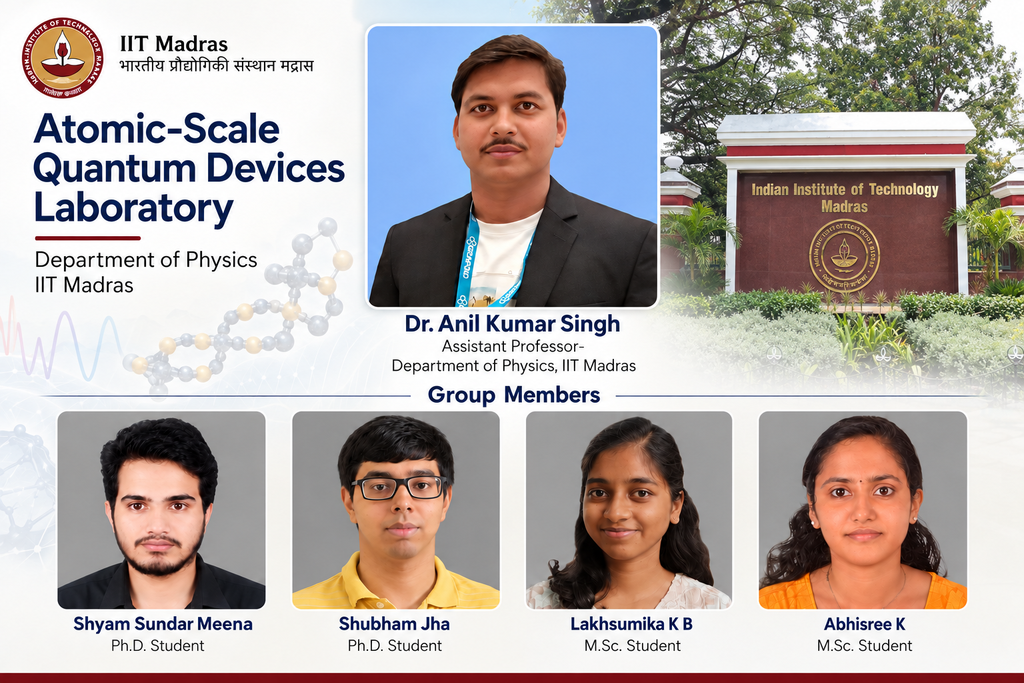
Dr Anil Kumar Singh, assistant professor at IIT Madras’ Atomic-Scale Quantum Devices Laboratory, was a corresponding author and the principal experimental contributor. The study shows that molecular motion can facilitate electron flow by enabling higher-conductance configurations.
Conducted at 4.2 kelvin, approximately −269°C, the experiments require further investigation to establish whether the effect can work reliably under practical conditions. Potential applications include molecular-scale switches and current-modulating components. The researchers also proposed exploring circularly polarised light and spin-polarised electrical currents to control molecular motion.