




A low-power AI accelerator adds advanced machine intelligence to existing embedded platforms, enabling computer vision, robotics and industrial inspection without requiring a complete hardware redesign or processor replacement.
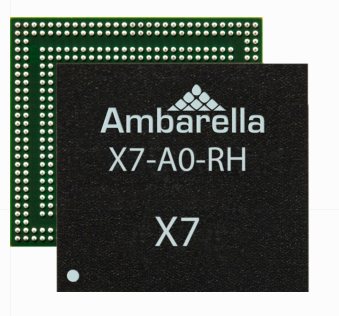
Ambarella’s X7 standalone edge artificial intelligence (AI) accelerator is designed to bring advanced AI inference capabilities to existing embedded systems powered by Arm and x86 processors. The chip enables manufacturers to add physical AI functions to cameras, industrial controllers, gateways and other electronic equipment without redesigning their existing platforms. It integrates the company’s third-generation CVflow computer vision and deep-learning processing architecture into a dedicated accelerator that works alongside a host processor.
The accelerator addresses the growing demand for AI processing in deployed electronic systems that were originally designed without support for modern neural networks. Instead of replacing the main processor or developing an entirely new system-on-chip (SoC), equipment manufacturers can use the X7 as a co-processor to execute additional AI workloads. In current customer designs, the device operates within a power envelope of 2 W to 5 W, helping embedded equipment meet power and thermal constraints while limiting additional system costs.
The X7 supports convolutional neural networks (CNNs), vision transformers, multimodal transformers and hybrid neural-network architectures. These capabilities allow embedded platforms to run multiple AI models for tasks such as object detection, visual inspection and scene understanding. Systems can combine conventional computer vision with vision-language models and natural-language interfaces, enabling more sophisticated analysis of data collected from physical environments.
The key features are:
- Third-generation CVflow computer vision and deep-learning engine.
- Cooper Model Garden support for compatible AI models.
- Model scheduling and memory-management capabilities for multi-model pipelines.
- LPDDR5 memory support in the XCalibur reference platform.
- Complete reference-design files planned to support production-module development.
For hardware integration, the accelerator connects to host systems through a single-lane Peripheral Component Interconnect Express (PCIe) Gen 3 interface or USB 3.2. Through PCIe, it appears to the host as a standard PCIe device. The architecture also supports integration with existing Ambarella processors, providing an upgrade path for products requiring additional AI performance.
Software development is supported through the Cooper Developer Platform, which provides compilation, model quantisation, profiling tools and C++ and Python runtime application programming interfaces (APIs). Existing perception pipelines developed for compatible Ambarella SoCs are designed to transfer to the X7 without requiring a complete software rewrite.
Applications include industrial inspection, intelligent manufacturing, physical security, mobile robots, drones, intelligent transportation, critical infrastructure and enterprise edge computing. The accelerator is also intended for gateways, kiosks and on-premises AI systems that need local inference capabilities.
For evaluation and development, the XCalibur reference platform combines the X7 with LPDDR5 memory on a standard M.2 2280 card. It supports multiple video streams and AI models simultaneously, with PCIe throughput exceeding 840 MB/s. The X7 is currently sampling, with evaluation kits available to qualified customers.
Click here for the original announcement.


