Routine programming is cheap now. Wording the wish is the new skill.
Software developers have always adapted to new tools, from command-line interfaces to integrated development environments and cloud platforms. Today, AI is changing software development not by replacing developers but by changing how they approach their work. As routine coding becomes easier to automate, developers are spending more time designing systems, solving business challenges, and making architectural decisions that AI cannot make on its own.

From punch cards to prompts
Software development has evolved alongside computing itself. From punch cards and command-line interfaces to modern integrated development environments (IDEs) and cloud-native platforms, every generation of tools has changed how developers build software. Community-driven platforms such as Stack Overflow further accelerated this evolution by making programming knowledge widely accessible and contributing to the broader body of technical information available to AI systems.
Modern AI-integrated development environments can reduce the time required to switch between multiple tools when solving programming problems. Instead of manually searching documentation or copying error messages into external AI assistants, developers can now access code generation, debugging assistance, and contextual recommendations directly within their development environment. More recently, AI agents have extended these capabilities beyond the IDE, generating test cases, identifying software defects, and resolving routine issues during scheduled development workflows. These developments indicate that AI is moving from a coding assistant towards a broader role in software development.
More than just a code machine
Although AI is often associated with automatic code generation, enterprise software development involves far more than writing source code. Large-scale software projects require developers to address system architecture, security, migration, optimisation, testing, and long-term maintainability, all while meeting business requirements and ensuring reliable operation. Consequently, AI is increasingly being viewed as a collaborative engineering assistant that supports multiple stages of software development rather than simply generating code snippets.
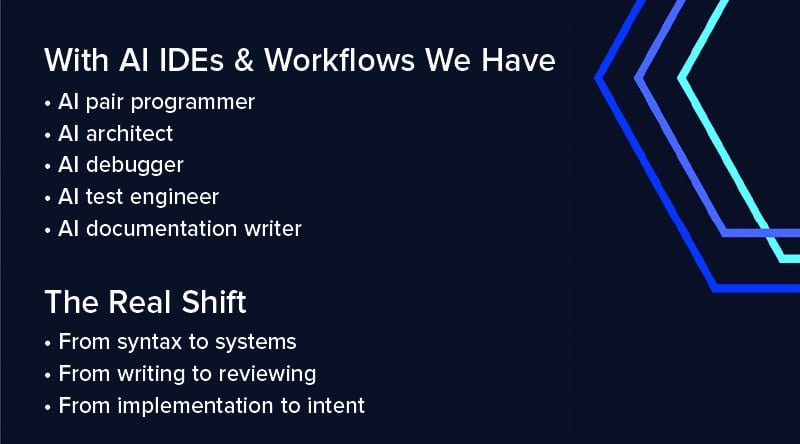
Within enterprise development environments, AI can assume multiple roles depending on the task. It can function as a pair programmer during implementation, assist architects in evaluating system designs, support debugging activities, act as a test engineer, and simplify technical documentation. This allows developers to concentrate on designing complete systems and solving business problems rather than repetitive engineering tasks. As development practices shift towards intent-driven engineering, organisations increasingly value developers who can translate business objectives into scalable software systems rather than simply produce functional code.
Four jobs, one assistant
AI is increasingly being used across multiple stages of software development. Rather than treating it as another coding assistant, organisations are using it to modernise legacy applications, evaluate architectural choices, connect knowledge systems, and automate repetitive engineering tasks. These applications affect not only how software is built but also how developers approach complex problems.