




What if remote controls, wireless sensors and other small devices could work without disposable batteries? Find out how.
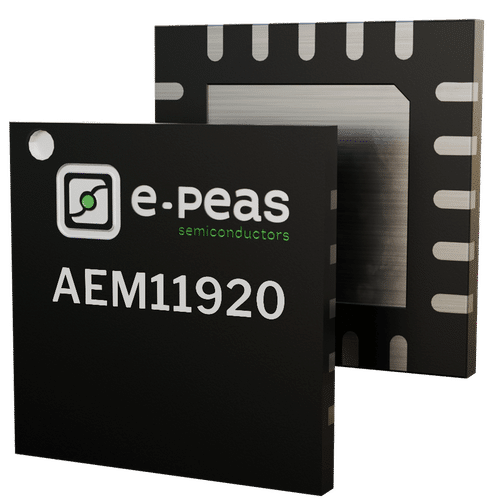
Recently, e-peas has launched a series of power management chips (PMICs) that help electronic devices run without disposable batteries. These chips are designed for devices such as remote controls, keyboards, computer mice, IoT sensors and smart home products.

All three PMICs share a common pinout, which enables OEMs to use the same PCB design to create device variants with two charging options. One is energy harvesting + 5V charging, in which the device can collect energy from sources such as a small solar cell (PV cell) and can also be charged using a 5V power source. The other is 5V charging only, which means that the device uses a 5V power source for charging, without energy harvesting. OEMs can switch between these options by changing the PMIC and making only a few other changes, such as adding a solar cell or modifying the device casing.
The series comes with average power monitoring (APM) functionality. It measures both the energy collected from sources such as solar cells and the energy supplied to the device (AEM11921), or measures only the energy supplied to the device (SPM10140). OEMs can design devices that automatically adjust their power consumption based on the available energy.
The AEM11920 and AEM11921 are PMICs that help electronic devices harvest energy from their environment (e.g. indoor light or other low-power sources) and use it to operate. They enable the manufacture of battery-free or very low-battery devices such as wireless sensors, remote controls and the like. They can harvest energy from sources that produce a voltage between 0.40V and 2.24V. They can be turned on with as little as 2.4 microwatts (µW) of available power. So, they can start operating even when the available power is extremely low.
The company claims that the SPM10140 is its first PMIC designed specifically for 5V charging only. It can deliver 50–400 mA of current to charge a battery using a 5V charger. Its built-in buck converter reduces the voltage to the level needed by the device and can supply up to 50 mA to its electronic circuits.


