Can compact hardware handle detection, classification and segmentation together? The platform can combine all three in a lightweight computer vision platform.
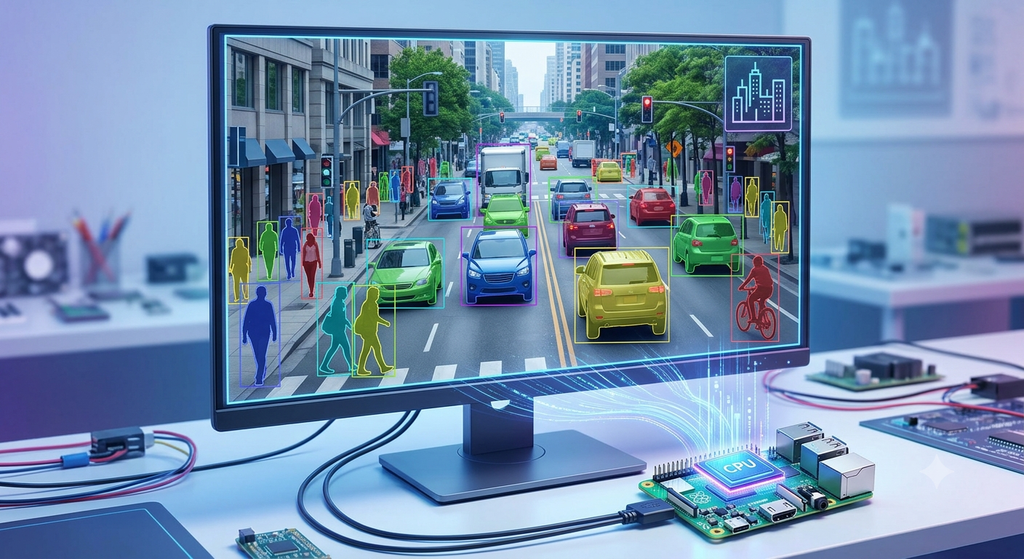
Comexp Research Lab has introduced TAPe+ML v3.5, a compact computer vision software platform that combines image classification, object detection and instance segmentation in a shared recognition core. With fewer than 100,000 parameters, the system is designed to run on a single CPU core without requiring GPU acceleration.

Computer vision often requires multiple models to be used for object detection, image classification and instance segmentation. TAPe+ML allows object detection, image classification and instance segmentation to be performed by building up a structured representation of the image before performing inference. The system also uses a learned region selector on larger images.
The system has been tested on a variety of CPU configurations including the Raspberry Pi 4, Raspberry Pi 5 and Intel N100. The system can infer at a rate of between 8.6ms and 34.7ms per frame using only one CPU core. The system can infer on the Raspberry Pi 5 in 20.4ms and the Raspberry Pi 4 in 34.7ms.
The model achieved 88.0% top-1 accuracy on the ImageNet-1k dataset. It achieved 71.1 box average precision (AP) on the COCO validation set. For instance segmentation it achieved 60.3 mask AP. The system achieved 66.0 and 58.0 on the COCO test set.
The full system has a total file size of around 4.2MB. This includes the model weights, inference code and libraries. The system can be used with the TAPe+ML workbench allowing users to upload images, annotate, train, evaluate and integrate with APIs.
The system is available to use via the online platform. The system can be provided locally to integrate with devices and on-premise. Some new processors might require some adjustment to get working.
For the official announcement, click here.