

The helmet automatically adjusts 32 sensors to maintain proper contact with the scalp and improve brainwave readings.
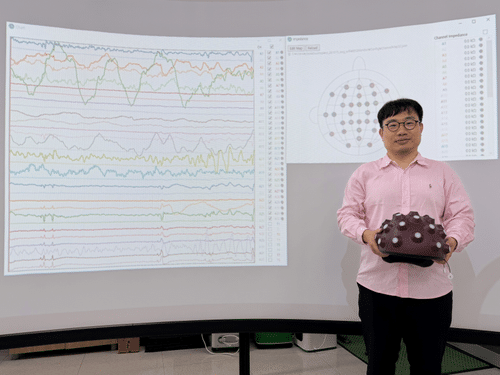
A research team led by Dr Seungchan Lee, Senior Researcher at the Department of Diagnostic Sensors of the Daegu-Gyeongbuk Convergence Research Division at the Korea Institute of Machinery and Materials (KIMM), has developed a helmet which can measure EEG signals from 32 channels, each sampled at 500 Hz. The system automatically checks whether the electrodes (sensors placed on the scalp) are making proper contact with the skin. It also adjusts their positions mechanically and checks again to ensure they are correctly placed.

A self-adjusting EEG helmet has been developed to measure the electrical activity of the brain (brainwaves) more easily and accurately. The sensors used in the helmet are called electrodes. They are in contact with the skin of the head and measure the brain signals. They continuously check for proper contact between these electrodes and the scalp. In case there is improper contact, the helmet repositions them accordingly. This is advantageous since different individuals may have varying head sizes and hair types, which can make it difficult for the EEG sensors to maintain proper contact.
The helmet has 32 electrodes (sensors) placed at 32 distinct scalp locations, recording brain signals at the same time. The signals are recorded 500 times per second. It produces a small electrical test signal through the bias electrode, and its feedback enables the helmet to check the state of the contacts between the other sensors and the scalp. In case there is improper contact, it will move the sensors up or down (vertically) to enhance contact with the scalp. This is done using a closed-loop system, meaning that it checks for contact while moving the electrode until the desired contact is attained. The built-in algorithm continuously checks for proper electrode contact.
Dr Seungchan Lee, Senior Researcher at the Department of Diagnostic Sensors at KIMM, said, “EEG has significant potential in medicine, healthcare, and cognitive science, but adjusting electrode contact conditions has been complicated, and signal quality can vary among users.” He added, “Our technology automatically monitors electrode contact and adjusts electrode positions in real time, providing a foundation for easier and more consistent EEG data collection, even in environments requiring repeated measurements.”