

An ESP32 remote learns and retransmits infrared codes from existing controllers.
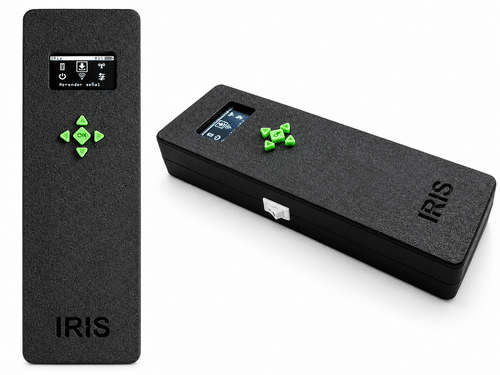
The Maker Nicolas Ruiz Neiman has come up with the IRis which is a programmable infrared remote with the ability to learn the signal from other remote controls and remember them for future use. It uses ESP32-WROOM-32 development board and comes with a 1.3-inch OLED screen and five buttons. It can also import remote definitions in the .ir format used by the Flipper-IRDB collection through an optional microSD card. Its Be Gone mode sends power-off codes for devices in a selected category.

Hardware consists of either an SSD1306 or SH1106 OLED display, an TSOP38238 IR receiver and two TSAL6200 IR LEDs. The NPN 2N2222 transistor is responsible for driving the IR transmitter LEDs, whereas there are five tactile buttons used for input from the user. An 18650 lithium-ion cell supplies power through an XL6009 boost converter set to 5V, while a USB-C charging module with protection is used to recharge the cell. Perfboard PCBs and 3D-printed PLA case are utilised in this design. All relevant files can be found in the repository.
The receiver is able to read the signals of the available remotes, whereas the LEDs are used to transmit the signals that have been stored in memory. The firmware decodes NEC, Samsung, Sony SIRC, RC5 and JVC signals, storing their protocol, address and command information. Signals from other protocols are retained as raw captures for replay. In addition, users may also load remote control definitions from the /irdb directory of the microSD card. The firmware is programmed in C++17 and created with PlatformIO, which uses the Arduino-ESP32 framework.
According to the author, the assembled remote controlled a TV from approximately two metres using two infrared LEDs, with an estimated current of 34mA per LED. The current was calculated using the values of the circuit instead of being measured. Despite the presence of firmware for several protocols of infrared, the hardware has only been tested with NEC remotes by the author. The tests conducted as part of this project are about 210 and are done on a PC, but do not ensure proper functioning of all functions on hardware.
However, there are some problems in the remote control unit. This remote control does not support decoding of a complete state command, which is commonly used by AC remote controls. Each key transmits just one frame rather than repeated transmission of frames. The battery meter gives an estimate of the battery capacity remaining. This remote control should be turned off when being charged since the charging module does not give any way to transmit power.
The firmware is available under the GPL-3.0 license, while the repository contains hardware specifications along with printer-friendly enclosures that can be modified. GPIO pin configurations have been consolidated in include/board_pins.h; thus, programmers can customise the pin configuration for use with other ESP32-compatible development boards.
For more information, click here.