




A new AI-enabled verification toolkit uses specialized engineering agents and physics simulation to automatically analyze signal and power integrity, assisting engineers in diagnosing problems in order to speed up the development of high-speed electronic systems.
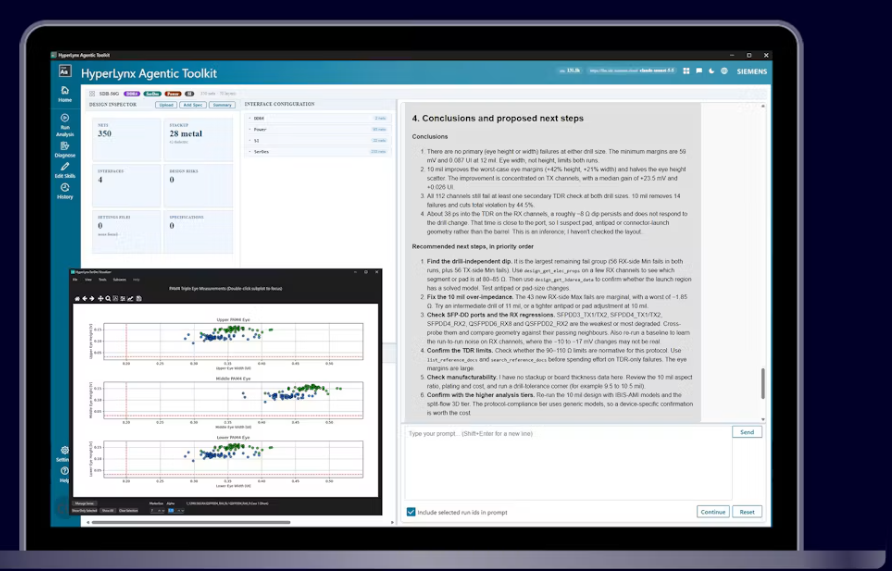
Siemens has launched the HyperLynx Agentic Toolkit – an artificial intelligence (AI) enabled software that automates electronic system verification and helps accelerate signal integrity (SI) and power integrity (PI) analysis. The toolkit uses specialized AI agents along with physics simulation to assist engineers in analyzing design problems.

The software is meant for dealing with the issues that come with the verification of increasingly complicated electronic systems that work at 112G and 224G speeds. The main purpose of the software is to ensure there is minimal manual work involved and to help detect any design issues early enough.
The key features are:
- Supports DDR5 simulation with compliance eye-mask visualisation.
- Provides scatter plots for eye-height versus eye-width analysis.
- Enables comparison of two electronic design alternatives.
- Supports PAM4 signalling analysis for high-speed interfaces.
- Provides visualisation of large-scale simulation datasets to identify problem areas.
The toolkit leverages the HyperLynx EDA software suite. It has an orchestration agent that helps control specialized agents for Serializer/Deserializer (SerDes), Double Data Rate (DDR), signal integrity and power integrity analysis. Engineers can trigger verification processes using natural language commands instead of manually setting up each step in the process.
These AI agents can run simulation processes, derive electrical parameters, analyze simulation results and evaluate performance against given design margins. This allows engineering teams to automate simulation analysis, technical specifications research, trend spotting, and failure causes investigations among other tasks.
A key aspect of the toolkit is its integration of AI with established physics-based simulation rather than relying solely on AI-generated predictions. This approach helps ensure that verification findings remain grounded in engineering analysis, allowing designers to examine potential problems and evaluate their impact on system performance.
The software also supports high-performance computing (HPC) and graphics processing unit (GPU)-accelerated simulations for faster analysis and deeper design-space exploration. Its applications include high-speed electronic board design, memory interface verification, SerDes analysis and complex signal and power integrity investigations.
Click here for the original announcement.

