




How can robots handle delicate objects without applying excessive force? The digitiser can bring faster, more sensitive tactile feedback to robotic hands.
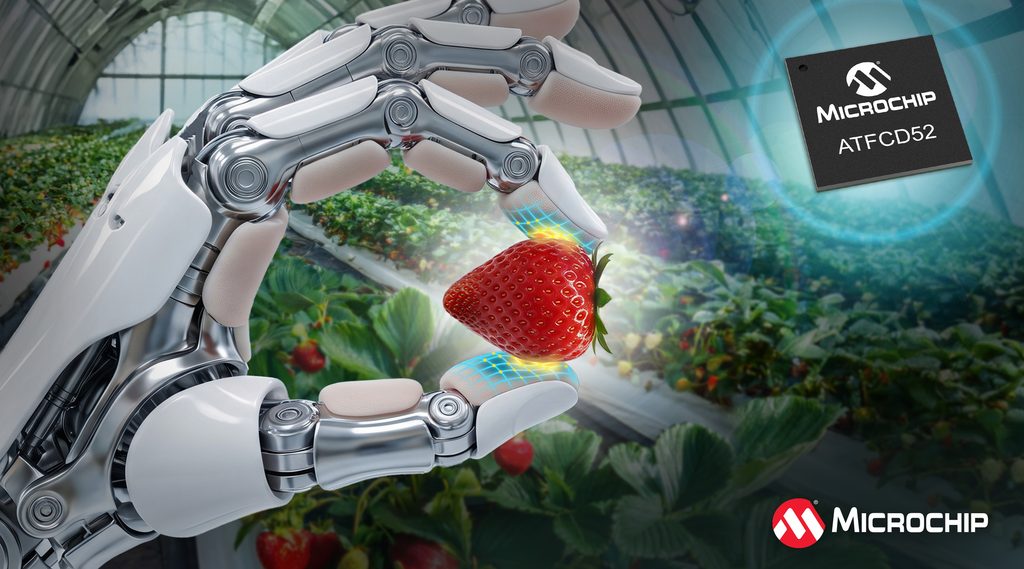
Microchip Technology has launched a high speed capacitance digitiser (ATFCD52), which gives robots the ability to ‘feel’. In addition to visual recognition sensors used by robots to locate objects, tactile sensing enables robots to understand the pressure and motion being applied, allowing robotic systems to understand the firmness with which objects are gripped.

Sensing information is captured using 2D fine resolution capacitive touch sensors that can be digitised using the new device. This data can be processed externally to determine both normal and shear forces. This enables precise gripping of objects, quick detection of slippage and manipulation of delicate objects using gripping devices and dexterous robot hands. This technology can also provide tactile sensing in augmented reality devices and gaming accessories, data collection gloves, foot pads and flexible electronic skins.
To capture contact information across the sensor surface, the ATFCD52 supports up to 52 channels, comprising 32 transmit (TX) and 20 receive (RX) lines. Its 20 parallel on-chip analogue front ends simultaneously acquire all receive lines, enabling frame rates of up to 800Hz, depending on sensor-array size. This allows robotic systems to acquire tactile data faster and respond to changes in contact.
The device also resolves capacitance changes below 1 femtofarad (fF), enabling it to detect subtle deformation in tactile sensor materials. To maintain sensing performance in electrically noisy environments, it uses frequency hopping and oversampling to help mitigate interference from servo motors, power electronics and switching regulators.
For system integration, the digitiser can be paired with microcontrollers (MCUs), microprocessors (MPUs) or field-programmable gate arrays (FPGAs). The EV-ATFCD52 development board supports evaluation of capacitive sensor designs, materials and stack-ups, while ATFCD52 Configurator software enables parameter configuration and real-time data logging. The device is available directly from Microchip and authorised worldwide distributors.
“The ATFCD52 is designed to deliver the real-time tactile data that serves as a foundation for the development of more dexterous robots and the advancement of physical AI,” says Giovanni Fontana, senior director of Microchip’s human machine interface division.
Click here for the official announcement.
